Déclic · Guides · Writing with AI
Comparison
Best plagiarism checker: free limits and how to read the score
Ad: this page contains affiliate links. If you buy or sign up through them, Déclic earns a commission at no extra cost to you. Our opinions stay our own.
In brief
There is no single best plagiarism checker, because the three covered here do different jobs and their free plans stop in different places. Quetext's free plan checks up to 1,000 words, GPTZero's page says its free plan covers up to 10,000 words a month, and Originality.ai's free Basic plan is for AI detection only, so it does not check plagiarism at all (all three as of October 2026). The bigger point is how to read the result: UK university guidance says a similarity score is not proof of plagiarism, and that a person has to look at what was matched.
Who it suits: students checking their own drafts before submission, writers and bloggers checking commissioned copy, and teachers who want a second look at a text they already doubt. Who it doesn't suit: anyone hoping a percentage will settle a misconduct question on its own, or who needs to check confidential work without reading the tool's privacy terms.
What does a plagiarism checker actually tell you?
A plagiarism checker compares your text against a database of other texts and highlights passages that match. It does not know whether a match is a lazy copy, a properly referenced quotation, a standard phrase or your own earlier work. Those are judgements for a person.
What the tool can give you is a map: which sentences match, which source they match, and how long each run of matching words is. That map is useful if you read it. It is misleading if you only look at the percentage at the top.
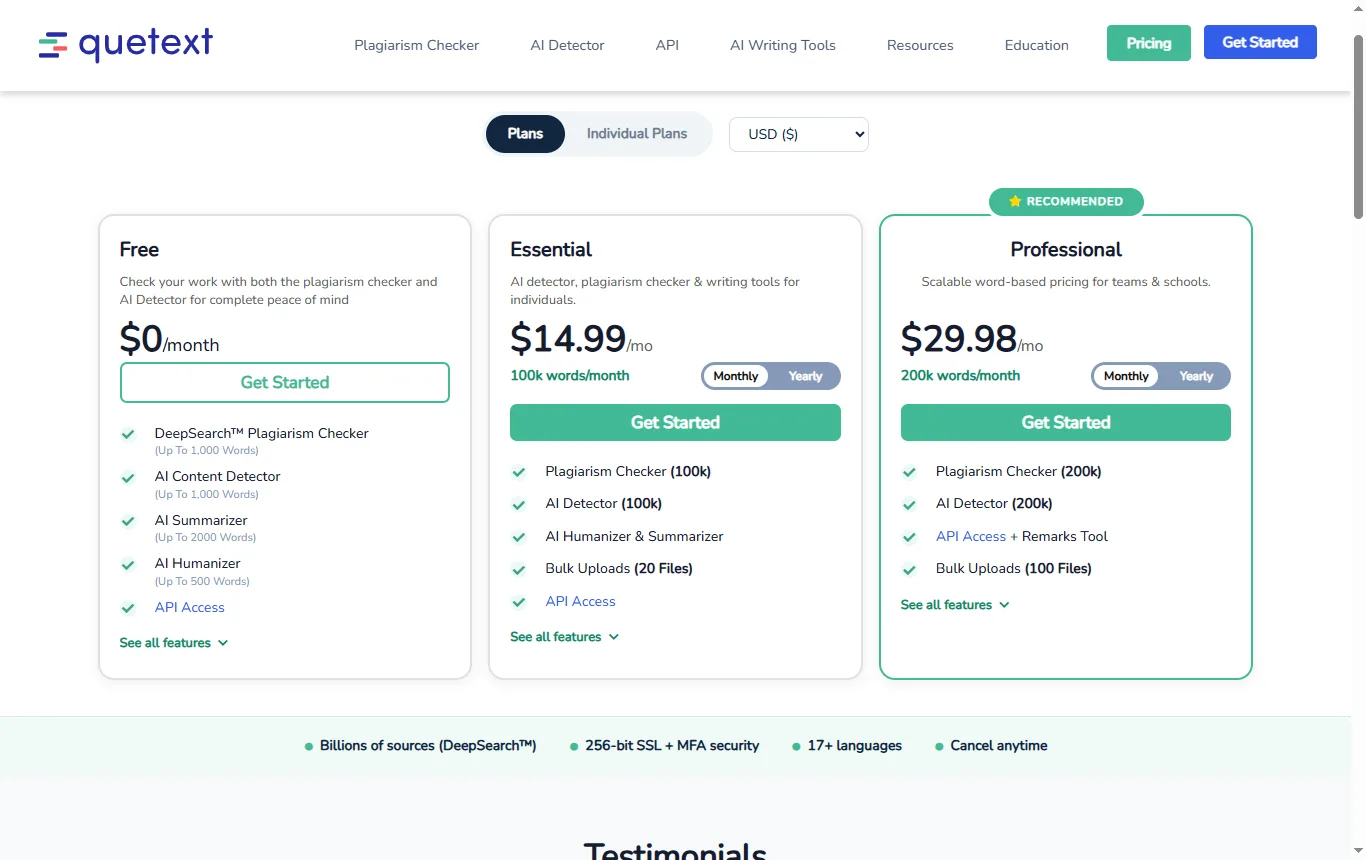
The sources a tool searches also decide what it can find. Originality.ai says its individual web users get a scan of publicly available web content through Google search, while its learning-platform and institutional users also get academic journal databases and a private repository of submitted work. GPTZero's plagiarism page says it checks against "over 100M scholarly articles, research papers, websites, and books" and links each flagged section to its source. Quetext's pricing page describes "billions of sources" through its DeepSearch feature. These are the companies' own descriptions; none of them lets you inspect the database.
Is a similarity score the same as plagiarism?
No, and UK universities say so in their own guidance. The University of Reading's staff guide to interpreting the Turnitin Similarity Report says the score shows only the amount of matched text, that "a similarity match does not always mean plagiarism", and that there is "no ideal percentage to look for", because the acceptable level depends on the type, length and requirements of the assignment. It says properly referenced quotations, reference lists and bibliographies, and common phrases or subject terminology can usually be set aside. It also notes that a 100% match suggests the work was previously submitted, which could be a resubmission, a mistake or collusion.
De Montfort University's guide for internal examiners goes the same way: "There is no threshold figure for the similarity score which reliably indicates evidence of plagiarism or not". It adds that a score below 20% is unlikely to indicate widespread plagiarism but that clear plagiarism can still sit in a small section, and that examiners should look at how the highlights are spread: short scattered matches are usually coincidental wording, while matches running across several sentences, paragraphs or pages suggest copying. It also reminds readers that a student quoting their own published work is not plagiarism. Neither guide shows a date, and the De Montfort material may be older, so check your own institution's current policy.
The lesson carries over to any checker, free or paid. Treat the percentage as a prompt to read the highlighted passages, not as a verdict.
What words will you meet in a similarity report?
Reports use a small vocabulary, and knowing it stops a lot of needless worry.
- Match. A stretch of your text that also appears in another text. A match says nothing about intent.
- Source. The page, article or submitted paper the tool found the match in. Always open it and read the original sentence.
- Similarity score. The share of your text that matches something. It counts quotations, references and common phrases as well as genuine copying.
- Quotation. Words taken from someone else, in quote marks, with a reference. These will match, and that is fine.
- Paraphrase. Someone else's idea put into your own words, still with a reference. A paraphrase that stays too close to the original sentence structure can still be highlighted.
- Self-matching. A match against your own earlier submission, which can be a problem under some institutions' rules even though the words are yours.
What do the free plans of Quetext, Originality.ai and GPTZero allow?
| Tool | What the free plan covers | Sources the company says it checks | Point to watch |
|---|---|---|---|
| Quetext | Plagiarism checker up to 1,000 words, AI detector up to 1,000 words, citation tools | DeepSearch across web pages, academic papers and published works | Prices can be shown in pounds on the pricing page |
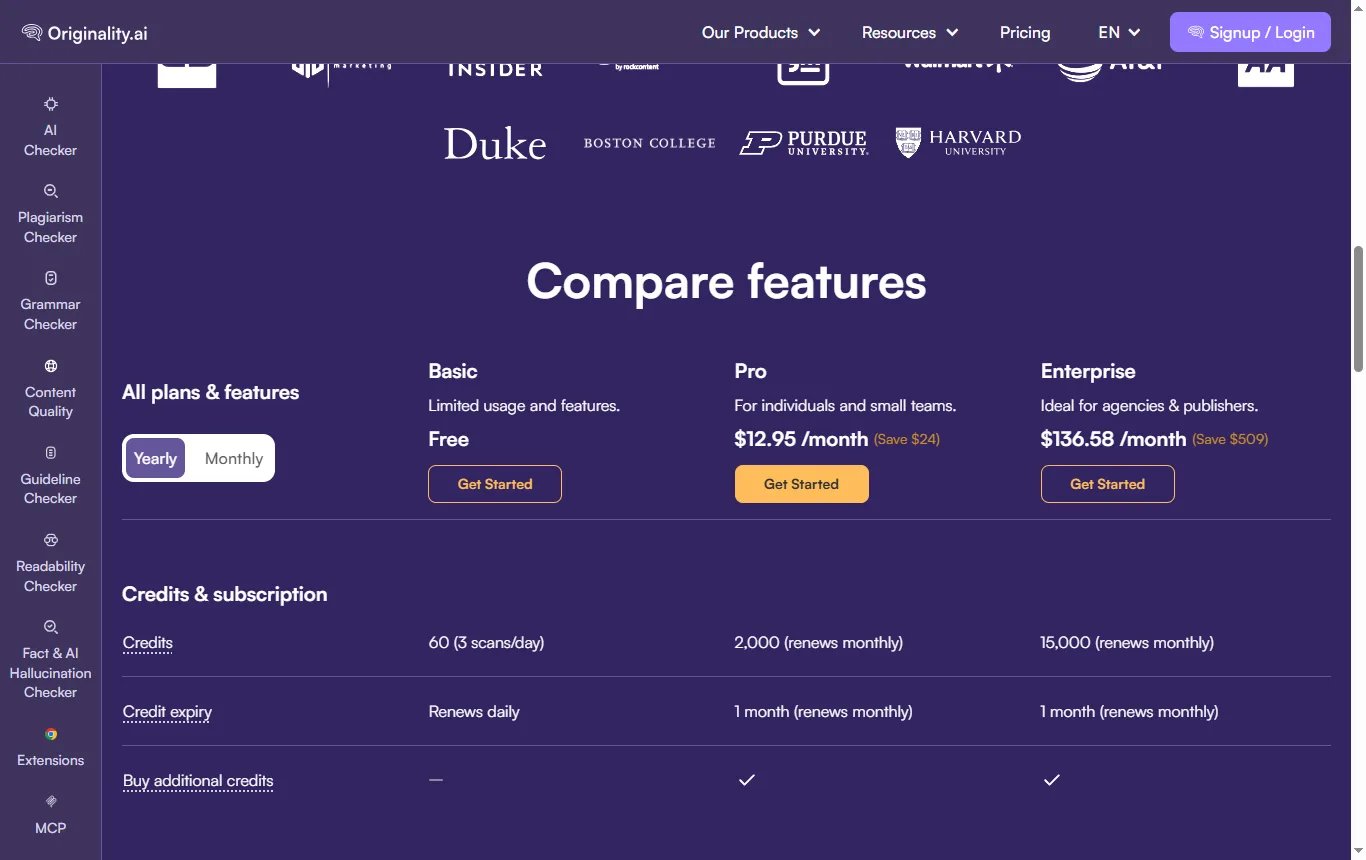
| Originality.ai | Basic plan is free but "AI detection only", 3 scans a day, up to 2,000 words a scan | Web via Google search for individuals; academic databases and a private repository for institutional users | The free plan does not include plagiarism checks |
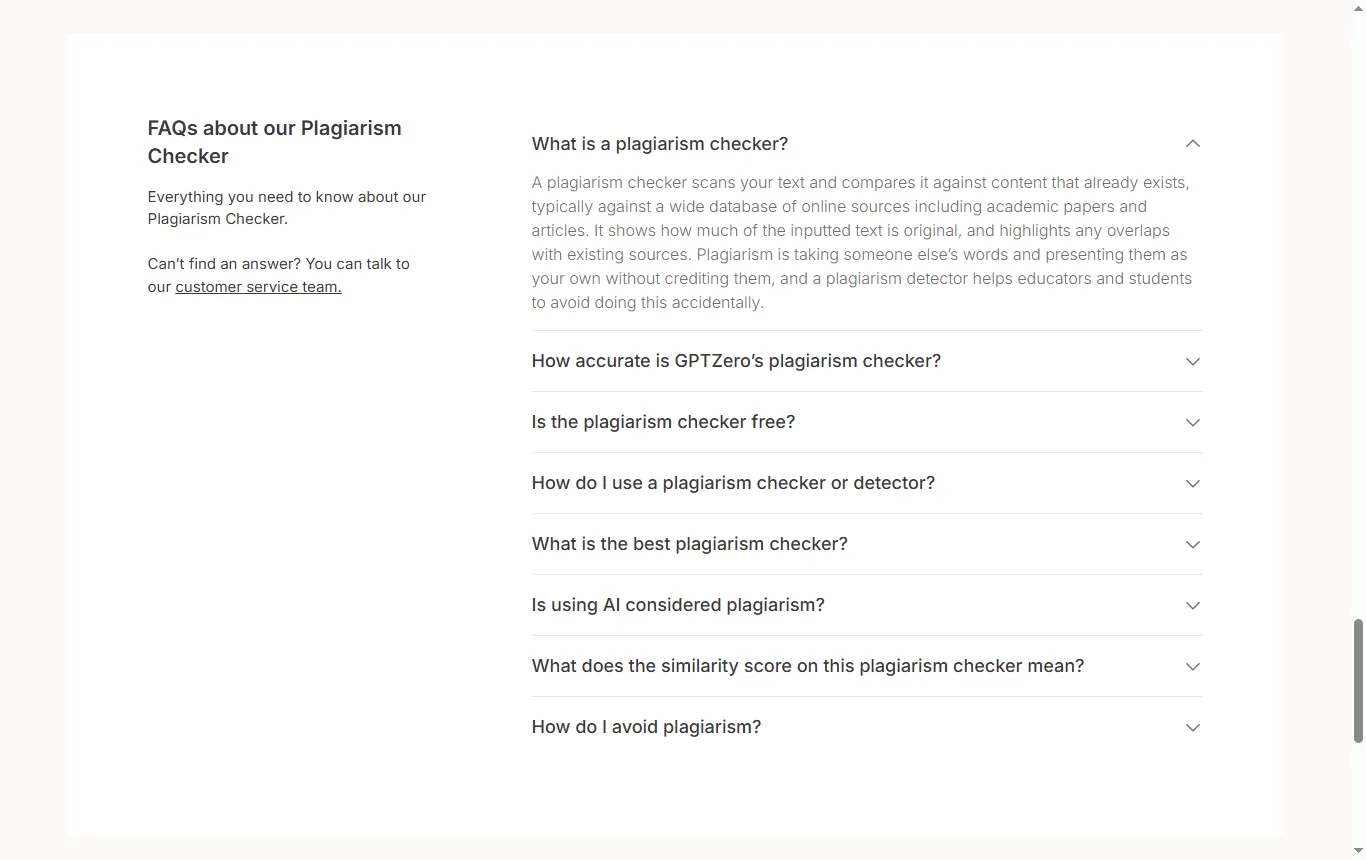
| GPTZero | Page says the free plan covers up to 10,000 words a month | Over 100 million scholarly articles, papers, websites and books, per its own page | The free allowance appears on the plagiarism page, so confirm it on the pricing page before relying on it |
Visit Quetext ↗ Affiliate link
Visit Originality.ai ↗ Affiliate link
Visit GPTZero ↗ Affiliate link
A 1,000-word limit covers a short essay section or a blog post, not a dissertation chapter. A 10,000-word monthly allowance goes further, but it is a monthly pot, not a per-document limit, so a few long checks can use it up. Check which kind of limit you are looking at before you plan around it.
How do the paid plans work, in words or in credits?
The tools bill in different units, which makes price comparison awkward. Quetext's Essential plan lists 100,000 words a month and its Professional plan 200,000 words a month, with plagiarism and AI checks each listed against those word counts. Originality.ai uses credits: its pricing page says "2 credits are used for 100 word checks of AI and Plagiarism", against one credit for an AI-only check on 100 words. Its Pro plan lists 2,000 credits a month, which works out at about 100,000 words of combined checks (2,000 credits divided by two credits per 100 words), or twice that for AI-only scans. Subscription credits expire at the end of each month; purchased credits expire two years after purchase.
Originality.ai says its prices are in US dollars, and the other pages show prices that change, so work out your real need instead: how many words will you check a month, how often, and do you need plagiarism, AI detection or both? Then compare the plans on the pricing pages the day you buy.
Which tool suits a student, a writer or a teacher?
These are starting points, not rankings.
- A student checking a draft. The free allowance matters most. Quetext's 1,000-word free check and GPTZero's monthly pot are the two to test; Originality.ai's free plan will not check plagiarism. Check one section at a time and keep the report.
- A writer or agency checking commissioned articles. Volume matters. Compare word allowances (Quetext) against credits (Originality.ai), and look at how a report is shared: Originality.ai says it offers a downloadable PDF report with the most matched sources. A freelance writer sending clients a clean report can use this as proof of process, as long as the report is read, not just attached. If you commission scripts for voice-overs, check them before you pay for narration; our ElevenLabs review → looks at one voice tool.
- A teacher or editor. The tool is a second pair of eyes. Reading and De Montfort both warn that the report needs a human reading it. Do not act on a number alone.
- A newsletter or blog owner. If you reuse product descriptions, supplier copy or older posts, a check shows where you have repeated text. If you send campaigns to a list, our Brevo review → looks at one free email service.
Are plagiarism checks and AI-text checks the same thing?
No. A plagiarism check looks for text that matches other text. An AI-writing detector estimates whether a text looks machine-written, and it gives no source to look at. The three tools offer both, and the free plans bundle them differently, which is why Originality.ai's free Basic plan is AI-only while Quetext's free plan includes both with a 1,000-word cap.
Keep the two results apart. A clean plagiarism report says nothing about who wrote the text, and an AI score says nothing about whether a passage was copied. Originality.ai's own FAQ says a plagiarism report "should not be used as the only measure to identify academic cheating", and that applies equally to the other tools. If your institution has a policy on AI use, read it and follow it before you submit anything.
Does it work for British English and other languages?
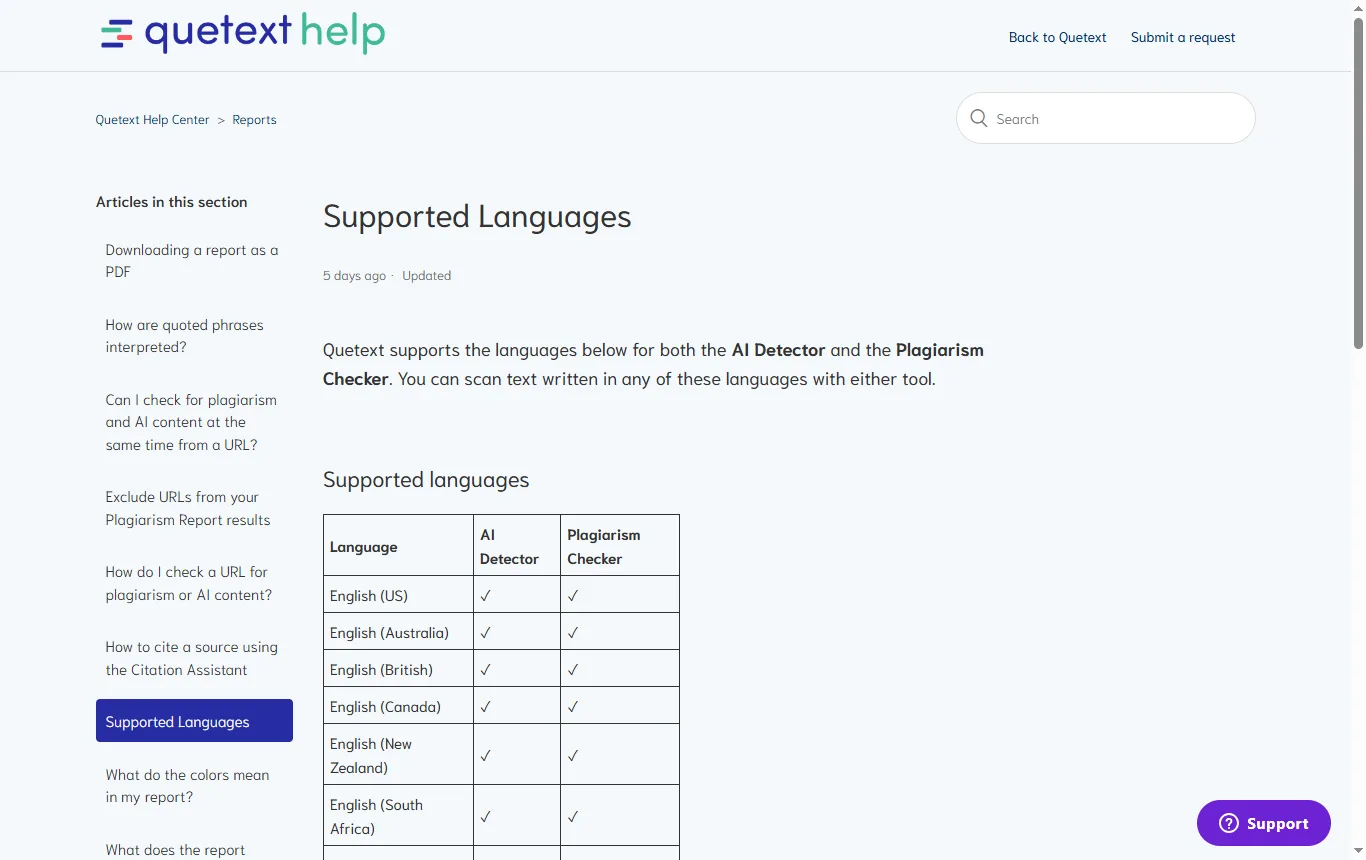
Quetext's help centre says it supports seventeen languages and variants for both its AI Detector and its Plagiarism Checker: English (United States, Australia, United Kingdom, Canada, New Zealand and South Africa), French, Spanish, German, Italian, Portuguese, Polish, Romanian, Dutch, Turkish, Vietnamese and Indonesian. The same list applies on the website, the API and the MCP server. The article does not say how good the results are in each language, so test a paragraph of your own before relying on it.
Originality.ai says its checker can scan non-English text and check Google search results for other languages. Spelling differences between British and American English rarely stop a match on copied text, but they can affect how a tool treats your own wording, so look at the highlighted passages rather than assuming a clean result.
Can you use Turnitin on your own draft?
Many UK universities use Turnitin, and it is the system behind a lot of the guidance quoted above. Whether you can see a similarity report on a draft before submission is set by your institution and your tutor. Turnitin's help pages describe the teacher's setting that decides when student submissions generate a similarity report, with options such as the first report being final or reports that can be overwritten until the due date, so some courses allow draft submissions while others do not. Ask your department rather than guessing.
Turnitin, Grammarly and Scribbr are not part of this selection, so check their current free allowances on their own sites.
What happens to the text you paste?
This question matters more than the percentage. When you paste an unpublished essay, thesis chapter or client article into a web tool, the text leaves your computer. Before you do, read the tool's privacy policy for three things: whether the text is stored, whether it is added to a database that other users' checks are compared against, and whether you can delete it. A text that is later compared against by someone else, or kept in a repository, can create problems for confidential or unpublished work.
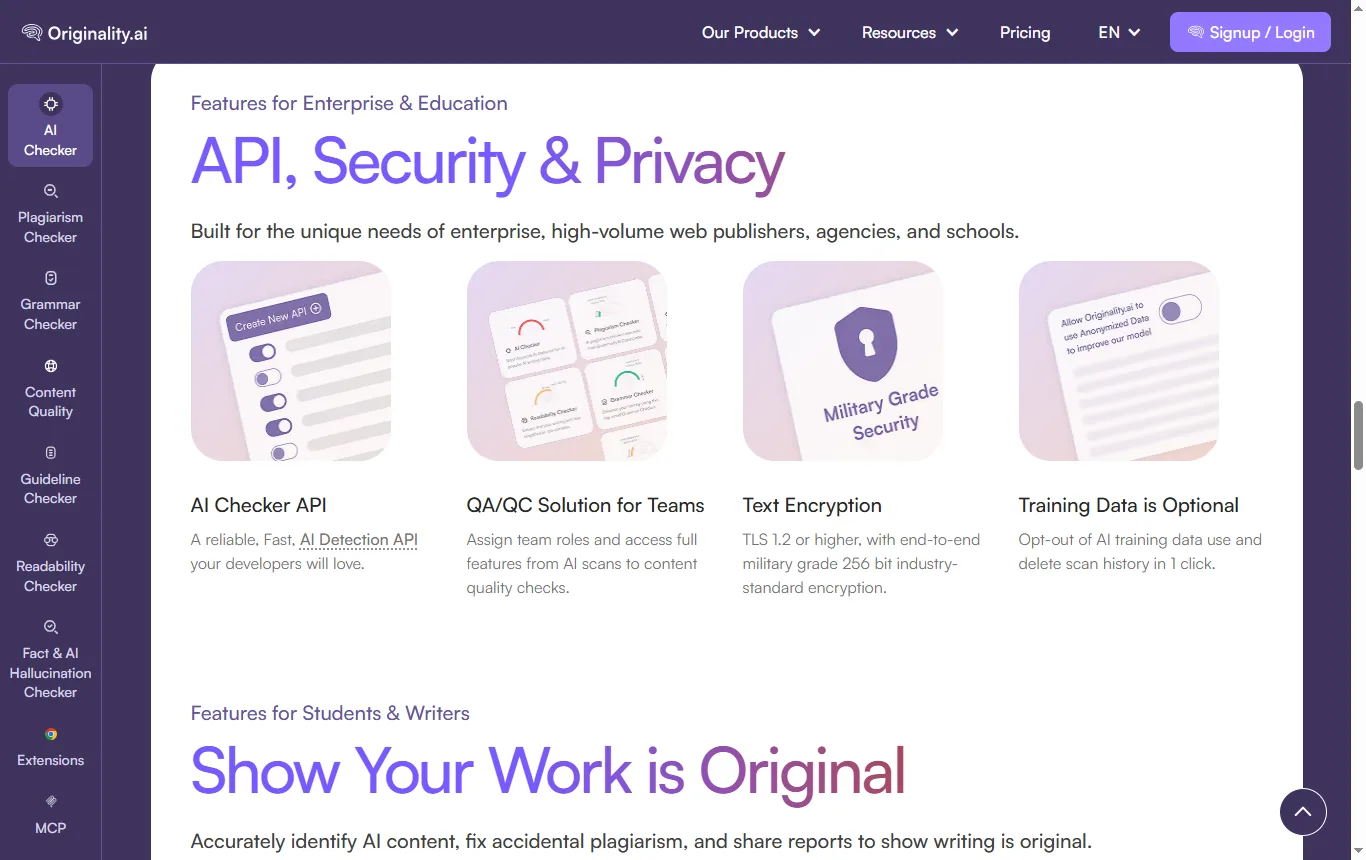
Originality.ai's home page says texts are encrypted with TLS 1.2 or higher using 256-bit encryption, and that you can opt out of data use for training and delete your scan history with one click. For Quetext and GPTZero, read the current privacy policy before you paste a text, because policies change. Whatever you choose, use a strong, unique password for each tool account; our guide to password managers → explains how a manager makes that easy.
How should you check your own draft, step by step?
- Finish the draft first. Checking a half-written text gives you matches you would have fixed anyway.
- Mark your quotations. Put direct quotations in quote marks with a reference before you run the check. Properly referenced quotations are the kind of match universities say can usually be set aside.
- Run the check one section at a time if the free limit is small, and keep the highlighted report.
- Read each highlighted passage. Ask: is this a quotation I referenced, a common phrase, a reference list entry, or a passage I took from a source without saying so?
- Fix the real problems. If you used a source, cite it and make the passage clearly your own explanation. If you quoted, mark it as a quotation.
- Check again and keep the final report with your notes, so you can show your process if anyone asks.
What should you do if your score looks high?
First, do not panic and do not rewrite everything. Open the report and sort the highlights into three piles: referenced quotations and bibliography entries (leave them), common phrases and subject terms (leave them), and passages you took from a source without a reference (fix them). Then look at the pattern, as De Montfort's guide suggests: scattered short matches are usually coincidence, while long runs across several sentences deserve attention. If a high figure comes from a text you submitted elsewhere, tell your tutor or editor rather than hoping nobody notices.
If a report is used against you, ask to see the highlighted version and the sources it matched, and ask which institutional rule applies. A bare percentage is not evidence on its own, and both university guides quoted here say so.
Which mistakes should you avoid?
- Chasing zero. A zero percent score is neither required nor a guarantee. Quotations and references will always match.
- Trusting one tool. Different tools search different sources and can disagree on the same text.
- Ignoring your own earlier work. Reusing material you submitted before can be a problem under your institution's rules even when it is your own, so check the rules.
- Using a score to accuse someone. The guidance quoted above says to look at the pattern of highlights. A number is where an enquiry starts.
- Pasting confidential text into a free tool without checking the privacy terms.
Not sure? Tell us what you are checking and why
Frequently asked questions
What is the best free plagiarism checker?
It depends on what you need to check. Quetext's free plan checks up to 1,000 words, GPTZero's page says its free plan covers up to 10,000 words a month, and Originality.ai's free plan does not include plagiarism. None is ranked here, because the limits differ and none gives you a verdict.
Is there a free plagiarism checker for students?
Quetext and GPTZero both have free allowances. Your university may also give you access to its own checking system, so ask your department first.
What is an acceptable similarity score?
There is no accepted figure. The University of Reading's guide says there is no ideal percentage, and De Montfort's guide says there is no threshold that reliably indicates plagiarism. Read the highlights, not just the percentage.
Does a plagiarism checker also detect AI writing?
They are separate checks. The tools covered here offer both, and a clean plagiarism result says nothing about who wrote the text.
Is Turnitin better than Quetext or Originality.ai?
They are not like for like. Turnitin is bought by institutions, and what you can do with it is set by your university; the tools here are open to individuals.
Is it safe to paste my work into a plagiarism checker?
Read the privacy policy first. Check whether your text is stored, whether it joins a database used for other people's checks, and whether you can delete it.