Déclic · Guides · AI video & voice
Review
ElevenLabs review: what the free plan, credits and licence really mean
Ad: this page contains affiliate links. If you buy or sign up through them, Déclic earns a commission at no extra cost to you. Our opinions stay our own.
In brief
ElevenLabs is a text-to-speech and voice cloning service, and its free plan is a way to listen before you pay, not a way to publish for free. Its pricing page (October 2026) shows 10,000 free credits a month, and its terms of use say free users may only use the service for non-commercial purposes; the first plan to list a commercial licence is Starter. If you want a narrated video for YouTube, a client or an online course, plan on a paid tier. If you only want to hear what a script sounds like, the free plan does that.
Who it suits: creators, course makers and small businesses who need narration in many languages and will check the licence before publishing. Who it doesn't suit: anyone who needs a free tool for monetised videos, or who cannot cope with a credit system that can run down faster than expected when you regenerate a line several times.
What is ElevenLabs and what does it do?
ElevenLabs turns written text into spoken audio. You paste a script, pick a voice, press generate and download the result. Around that core it offers voice cloning (making a synthetic copy of a voice from recordings), a project editor called Studio for longer pieces, and an interface for developers who want to add speech to their own apps. This review covers the part most readers ask about: the plans, the credits, the licence and the rules around cloning.
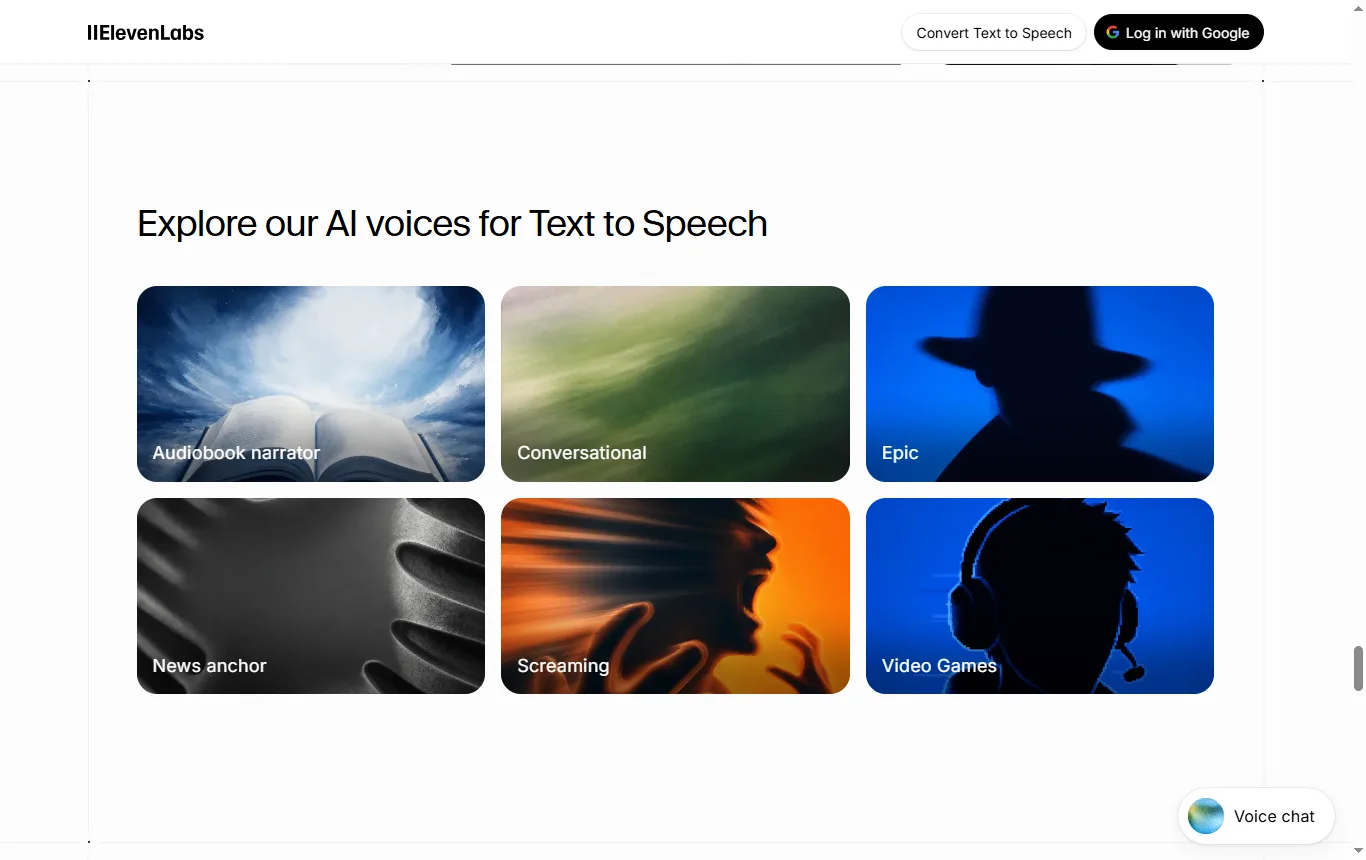
The company's text-to-speech page says you can generate speech in "90+ languages and wide range of accents" and filter voices by accent, such as American, British, Australian or Indian English. The numbers around it are less tidy: the same page quotes several different voice counts, from "10,000+" to "17,500+", and the plan table on the pricing page lists 74 languages for its model line, against the 90+ in the page text. The practical reading is that the library is large and changing, so no single figure is worth planning around. What matters is whether a voice fits your script, and that is something you check by listening, not by counting.
What does the free plan actually include?
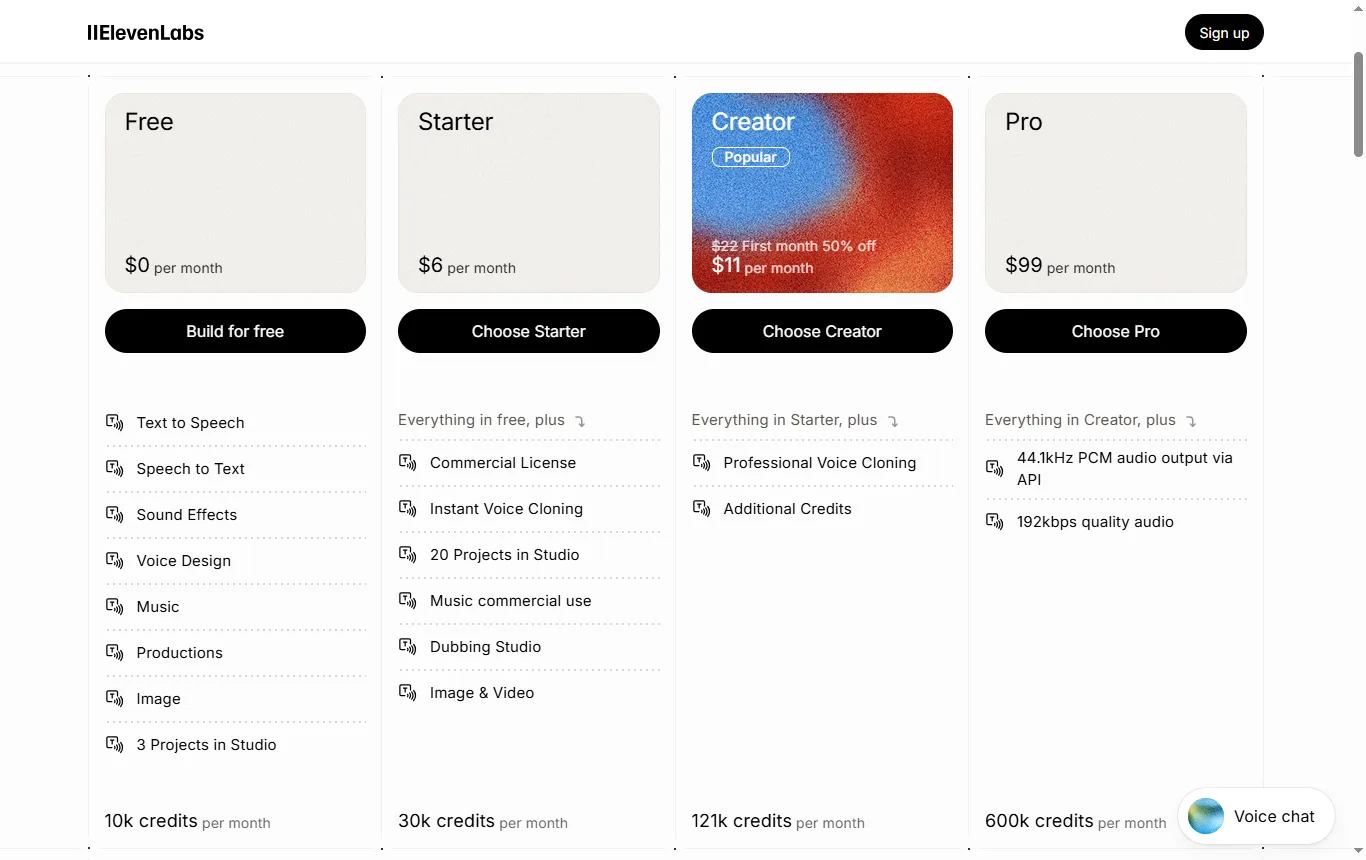
The pricing page lists seven tiers: Free, Starter, Creator, Pro, Scale, Business and Enterprise. The Free tier is shown with 10,000 credits a month and three projects in Studio. The company's FAQ describes this as around ten minutes of audio, with no card required. The Free feature list does not include voice cloning, and the pricing page does not list a commercial licence for it.
Two details are easy to miss:
- Prices are displayed in US dollars. The pricing page does not show pounds, so what you pay in sterling depends on your card and your bank's exchange rate. Prices change, so read the live page on the day you subscribe.
- Attribution. The FAQ on the text-to-speech page says the Free plan "covers personal, non-commercial use and requires attribution to ElevenLabs". The pricing page itself does not mention attribution. The two pages are not saying the same thing, so treat the stricter reading as the safe one and credit ElevenLabs if you share anything made on the free plan.
Visit ElevenLabs ↗ Affiliate link
Can you use ElevenLabs audio commercially?
This is the question that decides whether the free plan is any use to you. The terms of use say, in the section on free users, that they "may only use the Services for non-commercial purposes", and that paid users may use the service commercially while still following the Prohibited Use Policy. The pricing page lists a "Commercial License" starting at Starter, and the FAQ on the text-to-speech page names the uses it has in mind: YouTube videos, podcasts, adverts, audiobooks, games and apps.
In practice, "commercial" is wider than people expect. A video on a monetised YouTube channel, a voice-over for a client's advert, narration inside a paid course and a podcast with sponsors would all reasonably count as commercial use. A private audio file for a family presentation would not. If you are unsure which side of the line you are on, treat it as commercial and choose a paid plan, or ask ElevenLabs before publishing.
One more point from the terms: you keep your rights in the output, but the terms also say other users may receive the same or similar output. So do not assume a generated voice line is unique to you. If a line has to be distinctive, such as a brand slogan or a character voice, bear that in mind before you build on it.
How far do credits go, and what happens to the ones you don't use?
Credits are the currency of the service. According to ElevenLabs' own FAQ, 10,000 credits is roughly ten minutes of audio, which means a ratio of about 1,000 credits a minute for standard speech. On that ratio, a plan with 30,000 credits would give roughly thirty minutes, and one with 121,000 credits a little over two hours. That is an approximation, not a promise: the real figure depends on the model you pick, and every regeneration of the same line spends credits again.
The pricing page lists these monthly allowances:
| Plan | Monthly credits | Rough audio on the 1,000-credits-a-minute ratio |
|---|---|---|
| Free | 10,000 | about 10 minutes |
| Starter | 30,000 | about 30 minutes |
| Creator | 121,000 | a little over 2 hours |
| Pro | 600,000 | about 10 hours |
| Scale | 1.8 million | about 30 hours |
| Business | 6 million | about 100 hours |
| Enterprise | on request | not listed |
On unused credits, the page says they "roll over for up to two months, up to 2x your monthly quota", so a balance can reach three times the monthly allowance. Rollover needs an active paid subscription: it does not apply to the Free plan, and downgrading or cancelling forfeits what is left at the end of the cycle.
Some practical habits keep credits from vanishing:
- Draft and proofread the script before you generate anything.
- Generate a short test sentence first to check the voice and pronunciation.
- Generate in sections, so a mistake in line 40 does not cost you the whole script again.
- Keep the best takes and name the files, rather than regenerating from scratch.
Which languages and models are on offer, and does it handle British English?
ElevenLabs' models page lists several models. Eleven v4 is shown with 90+ languages and a limit of 10,000 characters per request; Eleven v3 with 70+ languages and 5,000 characters; Eleven Multilingual v2 with 29 languages and 10,000 characters; Eleven Flash v2.5 with 32 languages and 40,000 characters; and Flash v2 as English only. The Flash models are described as the ones made for real-time use and bulk conversion, and the page lists a lower price per character for API generations.
For a UK reader, the practical question is accent. The site lets you filter voices by British English, but a filter label is not a guarantee that a voice sounds right for your audience, say a Scottish place name read by a voice built on a southern accent. Paste a paragraph that contains the awkward words of your own script (local names, brand names, numbers, dates) and listen before paying. Check the character limit too: a long script has to be split into several requests on a model with a low limit.
What do public reviews say about ElevenLabs?
On Trustpilot's UK page (October 2026), ElevenLabs shows a TrustScore of 3.0 out of 5, labelled "Average", from 1,189 reviews, 505 of them in the previous twelve months. The split is 47% five-star and 38% one-star, so opinion is polarised rather than lukewarm. A review platform only shows people who chose to write, so this is a signal, not a measurement, and the figures move every week.
Recurring praise: ease of use, voice quality and cloning, and developers building voice products. Recurring complaints: unexpected subscription charges and hard-to-get refunds, credits used up quickly (including by regenerations), automated support that is difficult to get past, login problems and thin documentation. Some reviews also report fraudulent card charges; they cannot be checked from outside, and they appear here only because they appear in the reviews. If you subscribe, use a card you can monitor and keep the confirmation email.

Which jobs is ElevenLabs a good fit for, and which not?
Think in terms of the job, not the tool.
| Job | Does it fit? | What to check first |
|---|---|---|
| Narration for a monetised YouTube channel | Yes, on a paid plan | The commercial licence wording and your monthly minutes |
| Course or training videos | Yes, on a paid plan | Whether you will update scripts often, since each regeneration costs credits |
| Voice-over for a client's advert | Yes, on a paid plan | That your client contract allows synthetic voices, and the disclosure rules for adverts |
| A one-off private presentation | The free plan may be enough | Non-commercial use only, and the attribution requirement |
| Cloning your own voice for repeated work | Paid plans only | Written consent from every voice you use, your own included in a team |
| Cloning a colleague or a public figure | No, not without explicit consent | The Prohibited Use Policy |
If the narration sits inside a video you are building, the editor matters as much as the voice. Our Filmora review → covers one option for the editing side, and the guide to AI video generators → covers tools that make the footage itself, including the one in our Kling AI free plan review →.
How can you judge ElevenLabs yourself in twenty minutes?
You do not need to take anyone's word for how it sounds. Here is a method you can repeat on any text-to-speech tool:
- Take 150 words of your real script, including three awkward names and one number.
- Generate it with two different voices on the free plan.
- Listen on the device your audience will use, such as phone speakers or earbuds.
- Note every mispronunciation and every sentence where the rhythm is wrong.
- Regenerate the worst sentence once and see whether the fix is easy.
- Check how many credits that whole exercise used, and multiply by your real script length.
If the results are good and the credit cost fits your volume, a paid plan is reasonable. If you spent half your free credits on one paragraph, the maths will not improve with a longer script.
ElevenLabs or Murf: which suits which job?
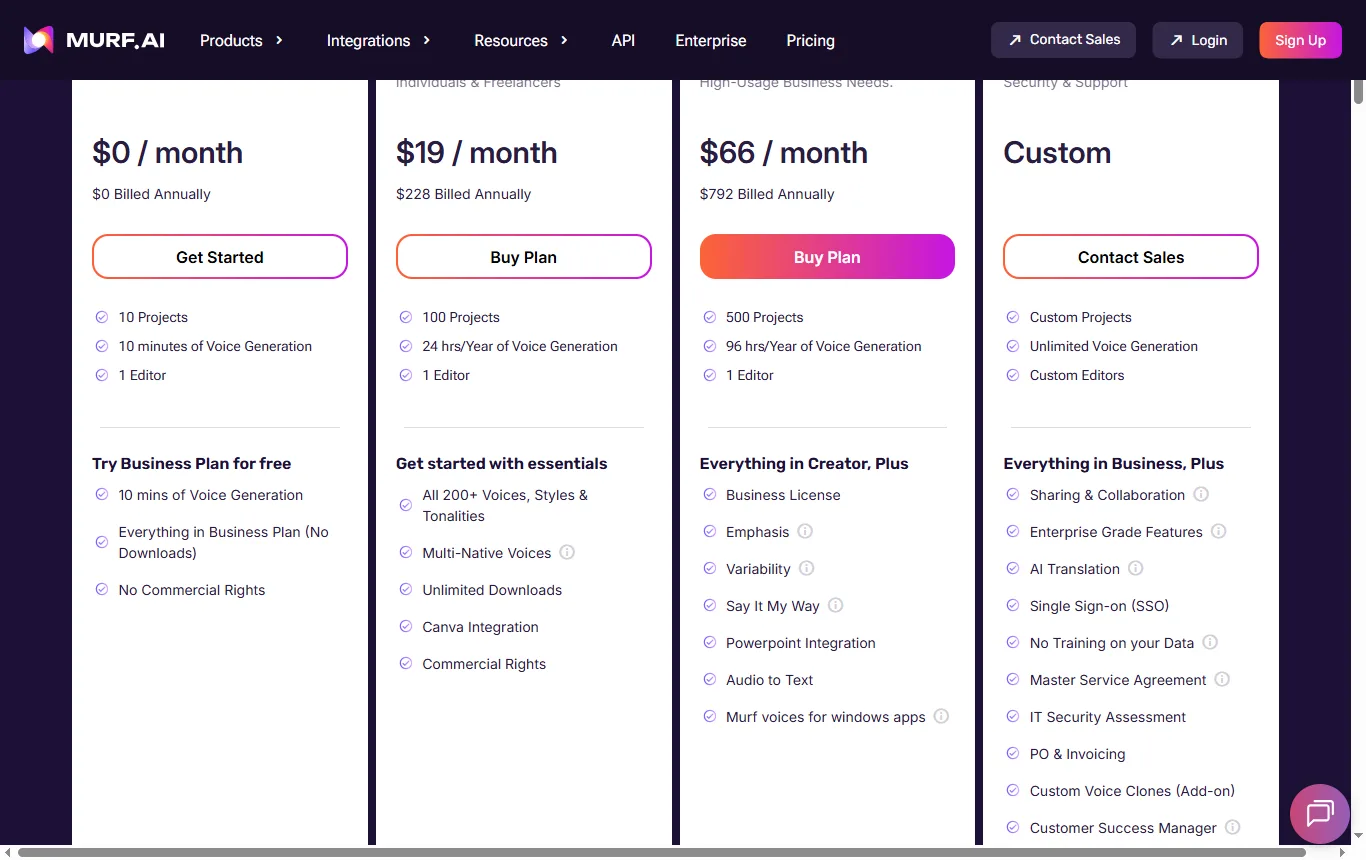
Murf is the other voice tool in this selection. Its pricing page (October 2026) shows a free Studio plan with 10 projects and 10 minutes of voice generation. The free trial of the Business plan is described as "without downloads" and "without commercial rights", and the FAQ says the free allowance has no time limit until the 10 minutes are used up, with unused minutes added to your account if you upgrade. Commercial rights and unlimited downloads begin with the paid Creator plan. Murf lists 200+ voices and 30+ languages and accents in Studio, and professional voice cloning appears only on the Enterprise plan in its comparison table. A separate API tab offers its own trial credit, unrelated to the Studio plan.
| Point | ElevenLabs | Murf |
|---|---|---|
| Free allowance | 10,000 credits a month, around ten minutes | 10 minutes of voice generation in total, 10 projects |
| Download and commercial use on the free plan | Non-commercial only, with attribution | Listening only in the trial, no download and no commercial rights |
| First plan with commercial rights | Starter | Creator |
| Voice cloning | Not in the Free plan | Listed on Enterprise only |
| Languages stated by the company | 90+ in the text, 74 in the plan table | 30+ languages and accents |
Both lock publishing behind a paid plan, so the free plans are for listening. The honest way to choose is the twenty-minute test above on both, with your own script, comparing the cost per finished minute. The tool that mispronounces fewer of your names and costs fewer credits for your volume is the better one for you.
Visit Murf AI ↗ Affiliate link
What are the rules on voice cloning?
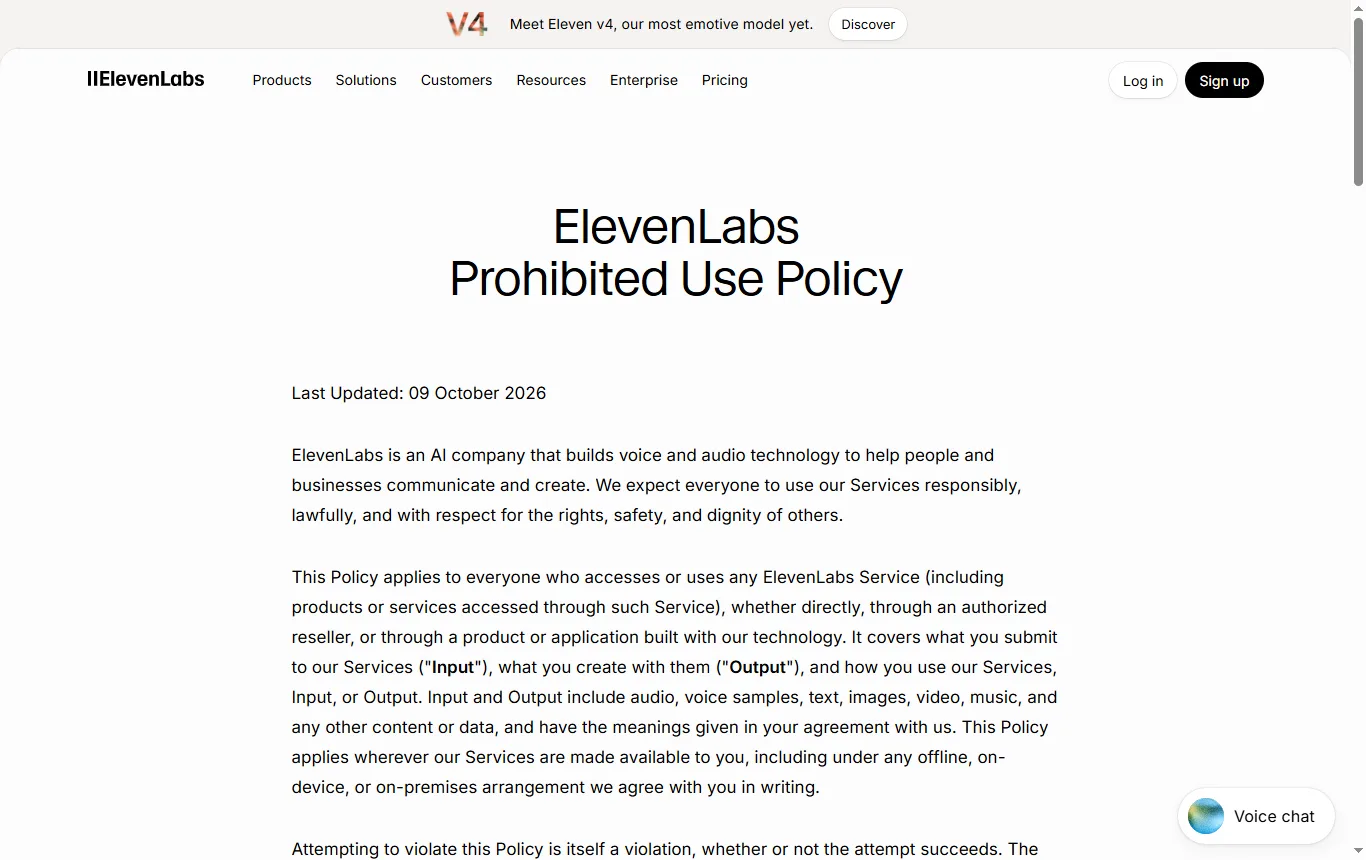
The terms of use are specific. Section 4(b) allows voice models only of your own voice or a voice you are authorised to share with ElevenLabs, and section 4(g) says you may not provide input or create output for which you do not have all the necessary rights. In plain terms: clone your own voice, or someone who has clearly agreed. Cloning a colleague, an actor or a public figure without permission breaches the terms, and the terms allow ElevenLabs to remove content or suspend access.
The Prohibited Use Policy, updated on 9 October 2026, goes further. It has twelve categories, including protection of minors, deception and impersonation, elections and civic integrity, privacy and personal data, the rights of others and AI transparency. It says cloning or impersonating a living person's voice needs their "explicit and informed consent", that voice recordings of anyone under 18 cannot be used to create or train a voice model, and that users must not remove, alter or conceal ElevenLabs watermarks.
Two sensible habits go beyond the minimum. Get consent in writing, saying what the voice will be used for and for how long. And tell your audience when a voice is synthetic, especially in content about real people.
Can you cancel, and do you get a refund?
Per the terms of use, subscriptions auto-renew until you cancel in your account, access continues to the end of the paid period, and the company says it will not refund subscription fees already paid. Prepaid credits are non-refundable except where the law requires otherwise, and section 6(e) says "All sales are final", with refunds at the company's discretion.
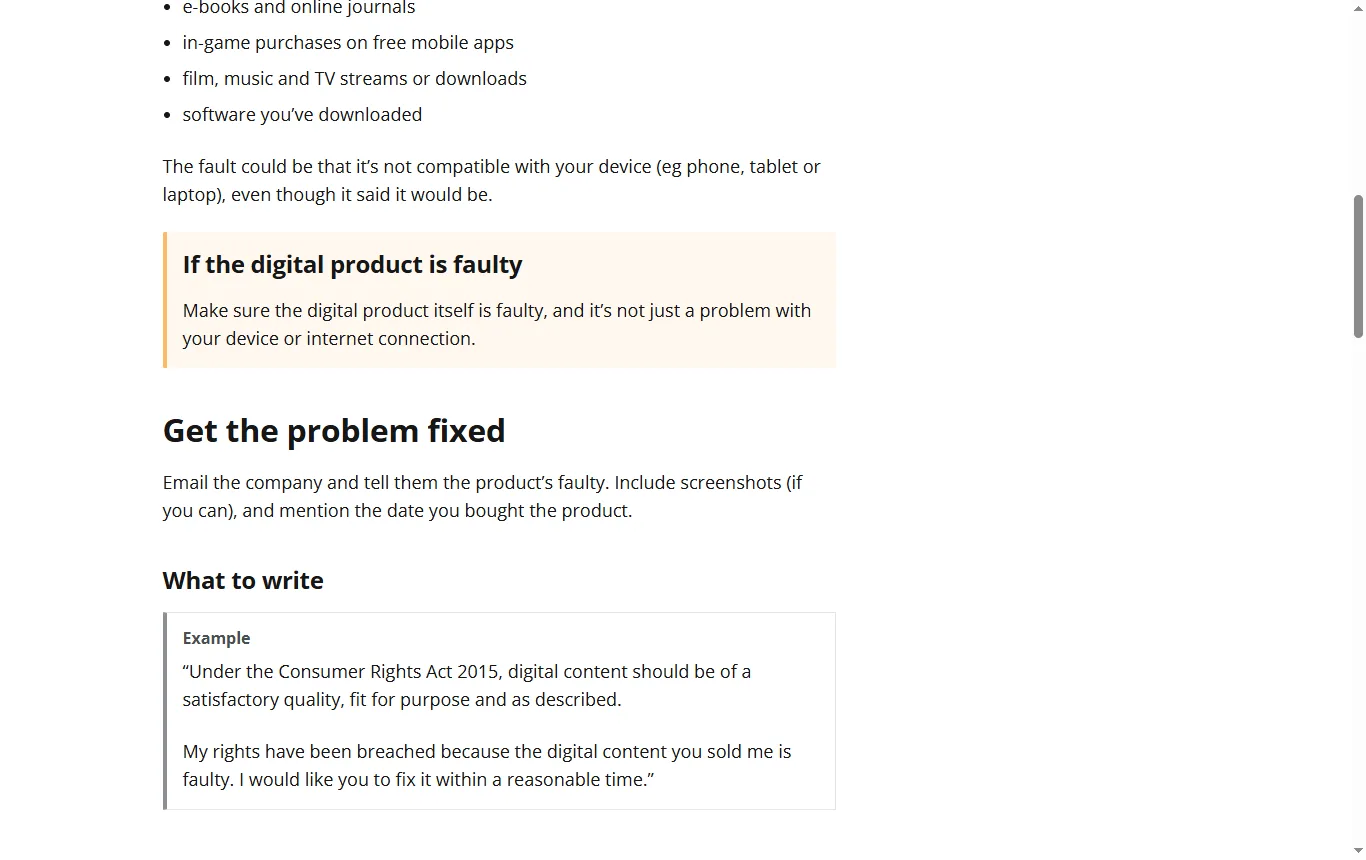
That reads strictly, and it matches the most common complaint in the reviews. As a UK buyer you also have statutory rights that a company's terms cannot remove. Citizens Advice, in its guidance for England, explains that digital content must be of satisfactory quality, fit for purpose and as described under the Consumer Rights Act 2015. If a service is faulty, you can ask for a repair or a replacement within a reasonable time, and then for a refund; unlike faulty physical goods, there is no automatic right to a full refund, and the amount depends on how long you have used it and what went wrong. If a fault damages your device you may be entitled to compensation, and if you paid by debit or credit card you can ask your bank about a chargeback. Those rights cover faults, not a change of mind about a plan you were happy with.
The cheapest protection is a calendar reminder: note the renewal date the day you subscribe, and cancel before it if you only needed one month of work.
What should you ask before you pay?
A short list, to keep next to the pricing page:
- Does the plan I am looking at list a commercial licence, and does the wording cover my use (monetised channel, client work, paid course)?
- How many minutes of audio will my real scripts need each month, with regenerations?
- Which model suits my language, and what is its character limit per request?
- What happens to my unused credits if I downgrade or cancel?
- Do I have written consent for every voice I intend to clone?
- When is the renewal date, and how do I cancel before it?
If the pricing page does not answer one of these, the support team is the place to ask, and a saved reply gives you something to point to later.
Is ElevenLabs worth paying for?
It is worth paying for if all four of these are true: you need narration at a regular rhythm, you have listened to your own script in its voices, the licence matches your use, and you have noted the renewal date. It is not worth paying for if you need a one-off 30-second clip, or if the free plan already gives you what you need for private use.
The recommendation is conditional on those points. There is no star rating here: the public score above comes from its customers, not from Déclic.
Not sure? Tell us what you are making
Frequently asked questions
Is ElevenLabs free?
There is a free plan with 10,000 credits a month, which the company describes as around ten minutes of audio. It is for non-commercial use under the terms of use, with attribution to ElevenLabs, and unused credits do not roll over on it.
Can I use ElevenLabs on a monetised YouTube video?
Not on the free plan: the terms say free users may only use the service for non-commercial purposes. A monetised channel is commercial use, so the paid plans that list a commercial licence are the ones to look at, and you should read the licence wording before you publish.
Does ElevenLabs have British accents?
The text-to-speech page says you can filter voices by accent, including British English. Whether a given voice suits your script is something to check by listening to your own text first.
How do I cancel ElevenLabs?
According to the terms, you cancel through your account, and access continues until the end of the period you have paid for. The terms say fees already paid are not refunded, so cancel before the renewal date.
Can I clone someone else's voice?
Only with their explicit and informed consent. The terms allow voice models of your own voice or of a voice you are authorised to share, and the Prohibited Use Policy bars impersonation without consent.
Is ElevenLabs better than Murf?
Neither wins on every job. The fair way to decide is to run the same script through both and compare mispronunciations and cost per finished minute.
See also
 GuideHow to animate a photo with AI for free (and what free really means)How to animate a photo with AI for free: a step-by-step method, what free tiers really include, consent, privacy and UK law, and when to go paid.
 ComparisonBest plagiarism checker: free limits and how to read the scoreQuetext, Originality.ai and GPTZero compared on free limits, sources checked, languages and privacy, plus how to read a similarity score without panic.