Déclic · Guides · Home & energy
Comparison
Best portable power station in the UK: how to choose one safely

Ad: this page contains affiliate links, including links to Amazon. If you buy through them, Déclic earns a commission at no extra cost to you. As an Amazon Associate I earn from qualifying purchases. Our opinions are our own, and we show no prices.
In brief
There is no best portable power station for everyone, because the right one depends on what you want to run and for how long. Two numbers decide most of it: capacity in watt-hours (how much energy is stored) and output in watts (how much it can supply at once). Add them up for your own devices, leave a margin, then compare recharging options, weight, sockets, noise and warranty. This guide does not rank products or show prices. It gives you the criteria, the mistakes to avoid, the safety points that UK and international bodies publish, and three searches on Amazon.co.uk to start from.
Who it suits: campers, campervan owners, people working outdoors and households that want backup power for small devices during an outage. Who it does not suit: anyone who wants to power a whole home by plugging a unit into a wall socket or the house wiring. That needs a qualified electrician, not a shortcut.
portable power station portable solar panel power bank for laptop Amazon affiliate links
How do I choose a portable power station?
Start with what you want to run, not with a brand.
- List your devices and their wattage. The label on the plug or the charger shows watts. A phone charger and a laptop charger are small loads, while heating, cooking and anything with a motor are large ones.
- Estimate hours of use. Multiply watts by hours to get watt-hours.
- Add a margin. The energy you can actually use is lower than the rated capacity because of conversion losses, so choose a unit with comfortable headroom. The manufacturer's specification is the place to look for stated efficiency.
- Check the peak. The unit's continuous output must cover the devices you run at the same time, and its surge rating must cover start-up spikes.
- Decide how you will recharge it: mains, car, solar panels, or several. Check the recharge time for each.
- Weigh the unit. A model you cannot comfortably carry is not a camping model.
Most mistakes come from skipping step 1 and buying on the largest number on the box.
What does a worked example look like?
The figures below are invented to show the method. Replace them with the labels on your own devices.
| Device | Power on the label | Hours of use | Energy needed |
|---|---|---|---|
| Laptop and charger | 60 W | 8 | 480 Wh |
| Wi-Fi router | 12 W | 10 | 120 Wh |
| Two LED lamps | 10 W each | 5 | 100 Wh |
| Two phones | 15 W each | 2 | 60 Wh |
| Total | 760 Wh |
A total of 760 Wh is the energy the devices consume, not what the unit must store: conversion losses come on top, so a unit holding comfortably more than 760 Wh is the sensible target. For output, add up only what runs at the same moment. Here the laptop, router, lamps and phones together draw well under 200 W, so output is not the constraint. If you added a kettle or a heater, it would become the constraint at once.
What do capacity and output actually mean?
Capacity (Wh) is the size of the tank. Output (W) is the width of the tap. A large tank with a narrow tap can run small devices for a long time but cannot run a heavy appliance at all. A small tank with a wide tap can start a power tool and then run flat quickly.
To show how wide the market is, here are models listed on the manufacturers' own range pages (October 2026). They illustrate how capacity and output vary independently of each other and are not a shortlist.
| Model | Capacity | Output | What the numbers suggest |
|---|---|---|---|
| BLUETTI Elite 30 V2 | 288 Wh | 600 W | Phones, tablets, a laptop for an evening |
| BLUETTI Elite 100 V2 | 1,024 Wh | 1,800 W | A weekend of small devices, a mid-sized appliance for a short time |
| BLUETTI Elite 200 V2 | 2,073.6 Wh | 2,600 W | Longer outages for several devices |
| BLUETTI Elite 300 | 3,014.4 Wh | 2,400 W | Large capacity, with output a little below the Elite 200 V2 |
| BLUETTI Elite 400 | 3,840 Wh | 2,600 W | Very large reserve; expect a heavy unit |
| BLUETTI Apex 300 | 2,764.8 Wh | 3,840 W | High output from a mid-sized store, for demanding tools |
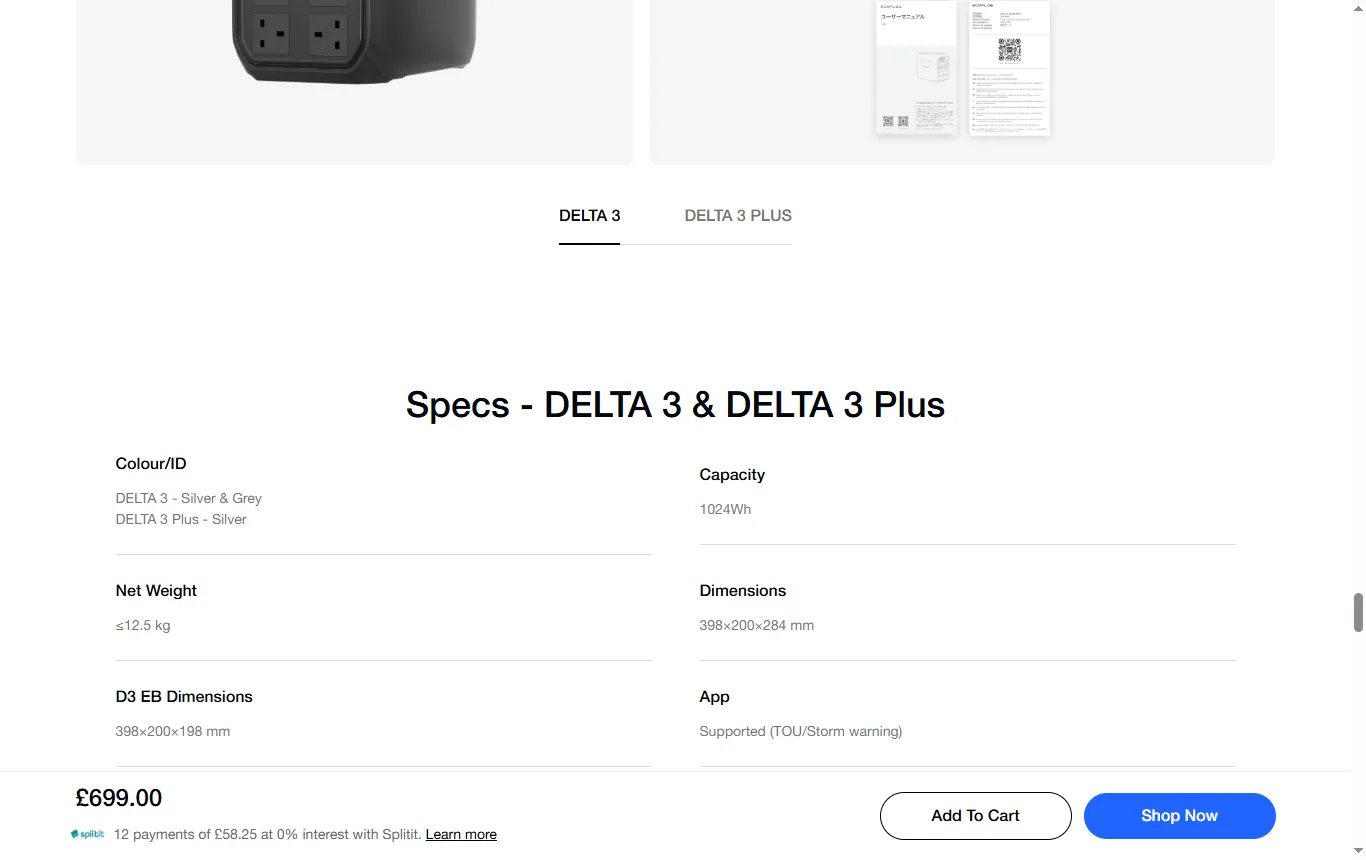
| EcoFlow DELTA 3 Plus | 1,024 Wh | Four AC outlets of 1,800 W each, X-Boost up to 2,400 W | Comparable capacity to the Elite 100 V2, with a different output approach |
Two things stand out. The Elite 300 stores more than the Elite 200 V2 but has a lower stated output, and the Apex 300 outputs more than any Elite model while storing less than the Elite 300 or the Elite 400. Capacity and output are separate choices. EcoFlow's DELTA 3 Plus figures come from its DELTA 3 series page; read the UK page for the exact model you are buying, including the warranty, before you compare.
Visit BLUETTI ↗ Affiliate link
Which features matter besides capacity?
- Sockets. Check which sockets the unit has and whether they suit your plugs. Also check USB-C power delivery if you charge laptops and phones directly.
- Battery chemistry. Manufacturers state the cell type in the specification. BLUETTI lists the Elite 400 as LiFePO4, and EcoFlow says the DELTA 3 series uses LFP cells that keep 80% of their capacity after 4,000 cycles. These are the makers' own claims, but they show what to look for, because chemistry affects lifespan and how the maker describes safety.
- Recharging. Mains charging speed, solar input limits and car charging vary widely. EcoFlow quotes a 56-minute mains charge for the DELTA 3 Plus and a solar input of up to two 500 W panels.
- Pass-through and backup behaviour. If you want the unit to act as a small uninterruptible supply for a router or computer, check that the specification says so and what the switch-over time is. EcoFlow quotes under 10 ms for the DELTA 3 series.
- Expansion. Some ranges accept extra batteries. That helps if your needs grow, but it adds cost and weight.
- Weight. EcoFlow lists the DELTA 3 series at up to 12.5 kg for 1,024 Wh. Capacity and weight rise together.
- Noise. Fans can be audible when charging fast or under load. Look for the decibel figure and the load it applies to.
- Warranty and UK support. Warranty lengths and conditions differ by range and sometimes depend on product registration. Read the official terms for the exact model, and look for how to claim in the UK.

Which portable power station is best for camping?
There is no single best. For camping, weight, recharge options and the output needed for your devices usually matter more than the largest capacity. This table pairs common situations with the questions that decide the choice.
| Situation | Typical devices | What decides the choice |
|---|---|---|
| Weekend tent camping | Phones, torch, small speaker | Weight and a small, light unit; recharging by car on the way |
| Campervan or motorhome | Fridge, lights, laptop, fan | Daily energy total, solar input and a fixed place to stow it |
| Working outdoors | Laptop, router, power tools | Continuous output, surge rating and sockets that match your plugs |
| Power cut at home | Router, lamps, phones, laptop | Capacity for several hours, pass-through behaviour and mains recharge time |
| Garden or event stall | Lights, small speaker, card reader | Quiet operation, enough sockets, a safe place away from rain |
If your list includes a fridge or anything that cycles on and off, remember that the start-up surge is higher than the running figure on the label. The surge rating in the specification is the number to compare. If the trip itself is still to be planned, our Trip.com review → looks at booking flights and hotels.
Who is better, Jackery or EcoFlow?
Searches often pit brands against each other, and so do the related searches for "ecoflow vs bluetti". There is no honest brand ranking here: specifications, warranty terms and prices change from one range to the next, and a ranking written from memory would mislead you. Jackery is not covered on this page. A fair comparison is one you build yourself:
- Pick the capacity and output you need.
- Shortlist two or three models of that class from different brands.
- Put the specifications in a table: capacity, output, sockets, recharge time, weight, warranty.
- Read recent owner feedback on more than one site, and look for repeated faults rather than single complaints.
- Compare the total cost, including any solar panels or extra batteries, on the day you buy.
Are battery-powered generators any good, and should I get one instead of a generator?
A portable power station stores electricity and releases it through sockets, with no fuel to carry. A fuel-powered generator makes electricity as it runs, and has its own safety rules around fumes, ventilation and refuelling, set out by manufacturers and safety bodies and not covered here. A power station is quiet and simple for small loads but cannot run heavy appliances for long, since its stored energy is limited. Which is better depends on the load, the duration and where you will use it. If you need to run a lot for a long time, work out the watt-hours first and see how large and heavy a unit that implies.
How should I plan recharging, including solar?
Recharge time is easy to estimate, and it is worth doing before you buy. Divide the capacity by the charging power: a 1,024 Wh unit charged at 1,500 W would take roughly 40 minutes in ideal conditions, against the 56 minutes EcoFlow quotes for the DELTA 3 Plus. Real times are longer because charging slows near full, so read the figure in the specification and the conditions behind it.
For solar, three limits apply together:
- The unit's solar input limit. It caps the power the unit will accept, however large the panels are.
- The panels' real output. The rated figure is a ceiling that you reach only in strong, direct light. In the UK, cloud, season and the angle of the panel reduce it.
- Your time. At low real output, refilling a large store can take days, which matters if you are away for a weekend.
For a trip, a sensible plan is to start with a full battery, charge in the car while driving, and treat solar as a top-up rather than your only source. For a power cut, charge the unit in advance and test it with the devices you would rely on. The second Amazon.co.uk search above covers portable solar panels, but panel connectors and voltage ranges differ by brand, so check compatibility in the unit's specification first.
How safe are portable power stations?
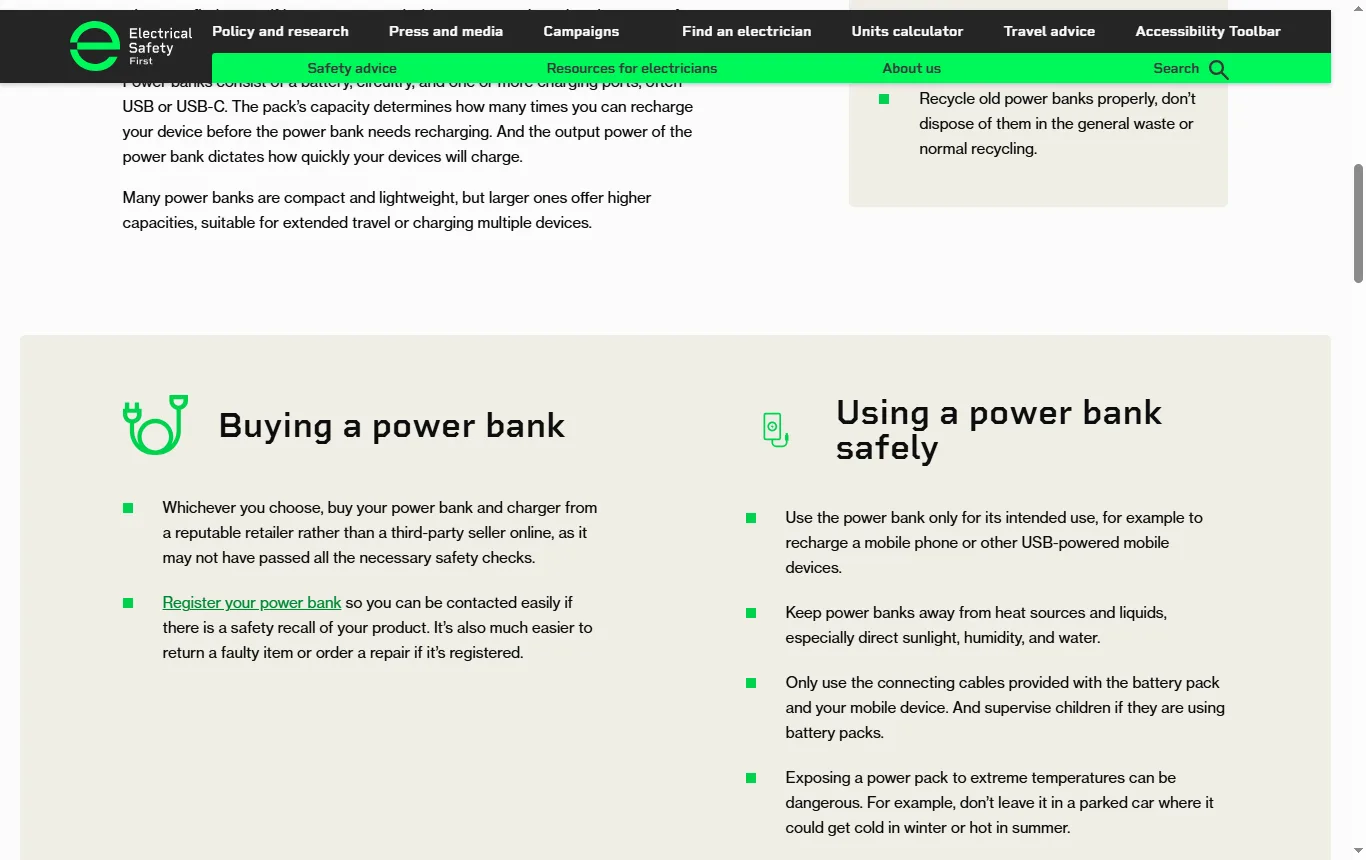
These units contain large lithium batteries. Electrical Safety First's advice on power banks (October 2026) is aimed at smaller packs, but its rules of thumb are sensible for any lithium battery product:
- Choose a known, trusted brand and buy from a reputable retailer rather than a third-party seller online, and register the product so you can be contacted about a recall.
- Use the cables supplied, unplug when the device is charged and charge it uncovered in a well-ventilated area.
- Avoid charging overnight or while you are out.
- Keep it away from heat, direct sunlight and moisture, and do not leave it in a parked car.
- Stop using it and unplug it if it becomes too hot to handle, smells odd, sparks, smokes or shows swelling or damage.
- Do not put lithium batteries in general waste or ordinary recycling; take them to proper battery recycling.
Can I take a portable power station on a plane?
The Civil Aviation Authority's advice of 22 July 2026 says power banks and spare lithium batteries should go in hand luggage rather than checked bags, that no more than two power banks per person are allowed, and that power banks must never be recharged onboard. That advice is about power banks.
For larger batteries, IATA's traveller guidance (October 2026) sets out the usual thresholds: up to 100 Wh is generally accepted in the cabin, between 100 and 160 Wh needs the airline's agreement, and above 160 Wh is generally not allowed on a passenger aircraft. Every model in the table above stores more than 160 Wh, so none of them is a flight companion. IATA also tells passengers to check their airline's own policy, because requirements differ by local rules. If you plan to fly with any battery, ask your airline before you pack it.

Can a portable power station power a whole house?
A portable power station can run plugged-in devices in a power cut, such as lights, a router or a laptop, if its capacity and output suit them. Connecting a unit to your house wiring is a different matter: do not do it yourself. If you want a home backup system, ask a qualified electrician what is safe and compliant, and follow the manufacturer's instructions for the specific model. A power cut is also a good moment to check that the recovery codes for your accounts are stored somewhere other than a phone that has just run flat; our password manager guide → shows how to organise them.
What mistakes do people make when buying a portable power station?
- Buying on capacity alone and then finding the output too low for a kettle, heater or power tool.
- Ignoring recharge time, so the unit is empty on the day it is needed.
- Counting on solar without checking the input limit and the panel's real output.
- Forgetting weight until the unit has to be carried.
- Buying from an unknown third-party seller with no clear warranty path.
- Leaving it plugged in permanently against the manufacturer's guidance.
- Never testing it before the trip or the winter.
- Planning around devices that barely use power. An e-reader, for instance, draws so little that a small unit or a power bank is plenty, as gifts for book lovers and e-reader choice → explains.
What are my rights if the unit is heavy, faulty or the wrong one?
Power stations are heavy, so the returns terms deserve a look before you click. Amazon.co.uk's returns policy (October 2026) says that most items can be returned within 30 days of delivery if they are new, unused and undamaged, and that the statutory right to cancel is 14 days from the day you receive the goods, for any reason. Amazon may reduce the refund if the item has lost value through handling. Amazon refunds return costs only for items sold or dispatched by Amazon that were advertised as eligible for free returns at the time of purchase.
Heavy and bulky items follow a separate route. Amazon defines them as items over 23 kg or with a side longer than 175 cm, and arranges a home collection through a specialist carrier. If the return reason is not that the item is damaged, defective or wrong, Amazon may deduct a £50 home-collection fee from the refund. For a marketplace seller, a separate help page applies, so read the seller's terms as well. The practical lesson is to decide on capacity and weight before ordering, not after.
What should you check before paying?
- Does the output cover the devices you will run at the same time?
- Is the capacity enough for the hours you need, with a margin?
- Which sockets does it have, and do they match your plugs?
- What are the stated recharge times, by mains, car and solar?
- What does the official warranty say, and who sells and supports the unit in the UK?
- Is the seller the manufacturer, Amazon or a reputable retailer?
- What are the delivery and returns terms, and what happens if the unit is heavy enough to need a collection?
- Is the model you are viewing the exact one in the specification, or an older or smaller variant with a similar name?
A short list of questions to put to a seller or to the maker's support, in writing, before you buy: which battery chemistry the unit uses, how many charge cycles the warranty assumes, whether the warranty needs product registration, who handles a claim in the UK and how long a replacement usually takes.
Not sure? Tell us what you need to power and for how long
Frequently asked questions
Who is better, Jackery or EcoFlow?
There is no ranking here. Compare the capacity, output, recharge options, weight and warranty of the specific models you are considering.
How do I choose a portable power station?
List your devices and their watts, estimate hours of use, add a margin, check the peak output and decide how you will recharge.
Are battery-powered generators any good?
For small loads they are quiet and fuel-free. For heavy loads over a long time their stored energy is the limit.
Which portable power station is the best for camping?
There is no single best. For camping, weight, recharge options and the output needed for your devices usually matter more than the largest capacity.
Can I take a portable power station on a plane?
The CAA advice concerns power banks. IATA's thresholds put anything above 160 Wh out of reach for passenger flights in general, and every model in the table above is larger. Ask your airline before you pack anything bigger than a power bank.
Can I plug a portable power station into my house wiring?
Not yourself. Ask a qualified electrician about a compliant installation.
See also
 ComparisonFolding treadmill buying guide: space, noise, knees and safetyHow to choose a folding treadmill or walking pad: belt size, space, noise, knees, NHS activity guidance and your return rights, plus a pre-purchase checklist.
 GuideBest adjustable dumbbells: how to choose in kilograms, for UK buyersAdjustable dumbbells for UK buyers: dial or pin, kg range and steps, per dumbbell or per pair, durability, recalls, heavy-parcel returns and NHS guidance.