Review
Trip.com review: is it safe to book flights and hotels in the UK?

Ad: this page contains affiliate links. If you book or sign up through them, Déclic earns a commission at no extra cost to you. Our opinions are our own.
In brief
Trip.com is a genuine online travel agency run by a listed company, not an obscure website. Whether it suits you depends less on the brand than on the ticket or room you choose, because cancellation rights, refunds and protection change from one booking to the next. Trustpilot's UK page (October 2026) shows 4.4 out of 5 from 209,375 reviews, with recurring complaints about slow confirmations, prices that move during checkout and support that is easier to reach by phone than by email. It works well if you compare several options and read the conditions before paying. It works less well if your dates are uncertain or a tight connection means any delay costs you money.
Who it suits: travellers who compare hotels, flights and trains side by side and are happy to read the fare rules of each offer. Who it does not suit: anyone booking something where a late confirmation would be expensive, such as a wedding, a group trip or a short connection between flights.
Who is behind Trip.com?
Trip.com is the international brand of Trip.com Group. According to the group's own story page (October 2026), the business began in China in 1999 as the Ctrip website, listed on Nasdaq on 9 December 2003, was rebranded as Trip.com Group in 2019 and listed again in Hong Kong in 2021. The same page names Skyscanner among the companies it has acquired. The UK terms of service name Trip.com Travel Singapore Pte. Ltd. as the operator, together with Trip Air Ticketing (UK) Limited.
None of that tells you whether your own booking will go smoothly. A large parent company means a real legal entity and a regulated listing, which is reassuring when you wonder whether a website is authentic. It does not replace reading the terms of your ticket. The sections below look at what customers report, what the UK terms say and which consumer protections apply.

Visit Trip.com ↗ Affiliate link
Is booking through Trip.com okay? What do UK reviews say?
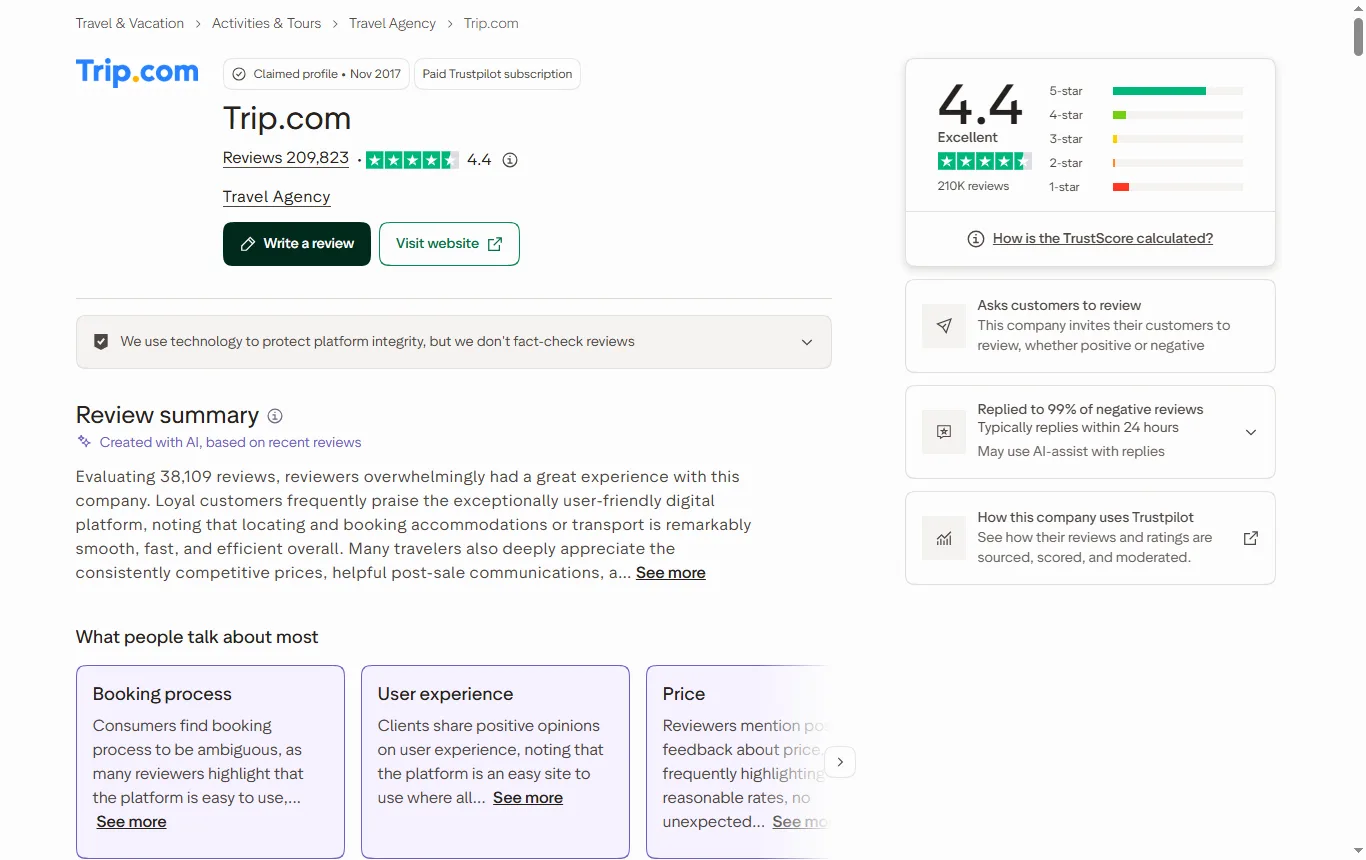
A review platform never represents every customer: people tend to write when things go very well or very badly. With that in mind, here is what Trustpilot's UK page for Trip.com showed in October 2026.
It lists a TrustScore of 4.4 out of 5 based on 209,375 reviews, 53,485 of them posted in the last twelve months. The split is lopsided: 72% are five-star and 13% are one-star, with very few in between. Trustpilot also displays a summary labelled as created with AI from recent reviews, which is worth reading as a pointer rather than as a verdict.
What recent reviewers praise
- Easy searching and booking on the website and in the app.
- Competitive prices on flights, trains and hotels.
- Support that resolved a supplier cancellation or a flight change quickly in some cases.
What recent reviewers criticise
- A slow website, technical errors and a cumbersome login.
- Ticket prices that sometimes rise late in the booking.
- Confusion over collecting or displaying digital train tickets.
- Mismatched names or email addresses between the booking and the airline.
- Payment problems, such as a card being blocked on an international transaction.
These are individual accounts. They show what customers complain about, not how many are affected, so they should not be read as a statistic. For a second opinion, read recent reviews on at least one other platform and compare the dates: a problem that was fixed two years ago matters less than one reported last week.
Is Trip.com an authentic website, and what do its UK terms say?
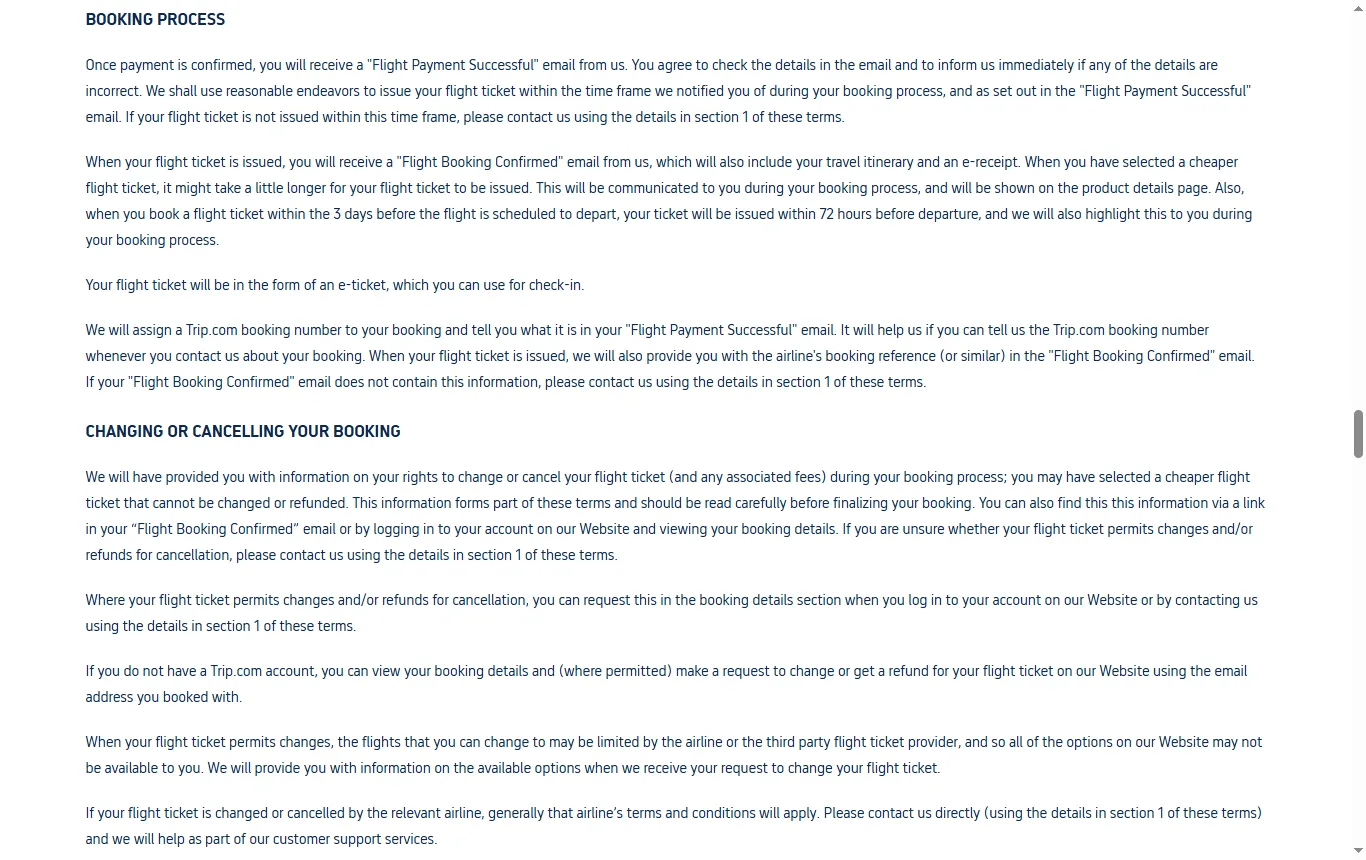
The terms for the UK site (uk.trip.com, updated 25 August 2026) are the ones that matter if you book there. If you use another country version, your terms may differ, so check the ones shown at checkout. In summary:
- Trip.com is an intermediary. It describes itself as a global online travel agency that helps you search for and book flights, hotels, trains, car rentals, transfers and attractions supplied by independent providers. Each provider's own conditions also apply and form a separate agreement with you. If the two conflict, the terms say Trip.com's apply.
- Cancellations and changes depend on the product. Rights are shown during booking and can be limited by the airline, hotel or other supplier. The terms tell you to check that a ticket or room allows changes before you book.
- If the supplier cancels or changes your booking, its own terms generally apply and you are told to contact Trip.com for help.
- Refunds go back to the original payment method unless Trip.com agrees otherwise, and the timing depends on your card or account provider. For a hotel booking that cannot be confirmed, the terms promise a full refund.
- Prices and availability. Prices are meant to be accurate, but if an error "should reasonably have been apparent to you", Trip.com may cancel the booking or, with your agreement, change the price. Availability is not guaranteed until the booking is confirmed.
- Liability. Trip.com excludes liability to the extent the law allows, including for incorrect booking details you enter and for events beyond its control.
- Governing law. Article 12 of the terms says Singapore law applies and Singapore courts have jurisdiction, without depriving a consumer of the mandatory rights of their country of residence, including the right to bring a claim in the courts there.
What this means in practice: the fare you pick decides almost everything. A non-refundable rate stays non-refundable however reputable the website is.
Are flights booked through Trip.com ATOL protected?
ATOL is the UK scheme that protects many holidays that include a flight if the seller fails financially. The UK terms state that, for ATOL-protected flight sales, Trip.com provides financial protection under its Air Travel Organiser's Licence, number 11572, issued by the Civil Aviation Authority (CAA), and that you receive an ATOL Certificate when you buy a flight or a package that includes one. The number comes from the company's own terms, so it is worth checking it yourself: the CAA's "Check an ATOL" search lets you look up a licence holder by name or number.
Two cautions follow from the same terms. First, only bookings sold as ATOL-protected are covered, so look for the certificate rather than assuming. Second, "Bundle & save" bookings are described as governed by separate package holiday terms, which the terms link to. A hotel booked on its own is not an ATOL product.
The check takes a minute and works for any seller, not only Trip.com. Use it whenever a booking is large enough to hurt if the seller failed.
What are your rights if a flight booked through Trip.com is delayed or cancelled?
Your flight rights come from UK law and are owed by the airline, whichever website sold you the ticket. The figures below come from the Civil Aviation Authority's delays and cancellations pages (October 2026). They apply to flights covered by UK law, such as flights departing a UK airport.
Cancellations. You can choose between a refund for the unused parts of your ticket or an alternative flight, as soon as possible or later. The airline must provide food and drink, a way to communicate and, if you are rerouted to the next day, accommodation and transport. Compensation may be due only if you received less than 14 days' notice, and not when the cause was outside the airline's control, such as extreme weather.
Delays. Care is owed after two hours on short flights, three hours on medium flights and four hours on long flights. Compensation applies when you arrive more than three hours late: £220 per person under 1,500 km, £350 between 1,500 and 3,500 km, and over 3,500 km £260 for three to four hours late or £520 for more than four hours. Airlines do not have to pay if they consider the delay was caused by extraordinary circumstances. All figures are per person.
If you booked through an agency, the practical difference is the route: you usually claim from the airline operating the flight, and the agency is a second party to keep informed. Keep your confirmation email and every receipt.
Does Section 75 protect a Trip.com booking?
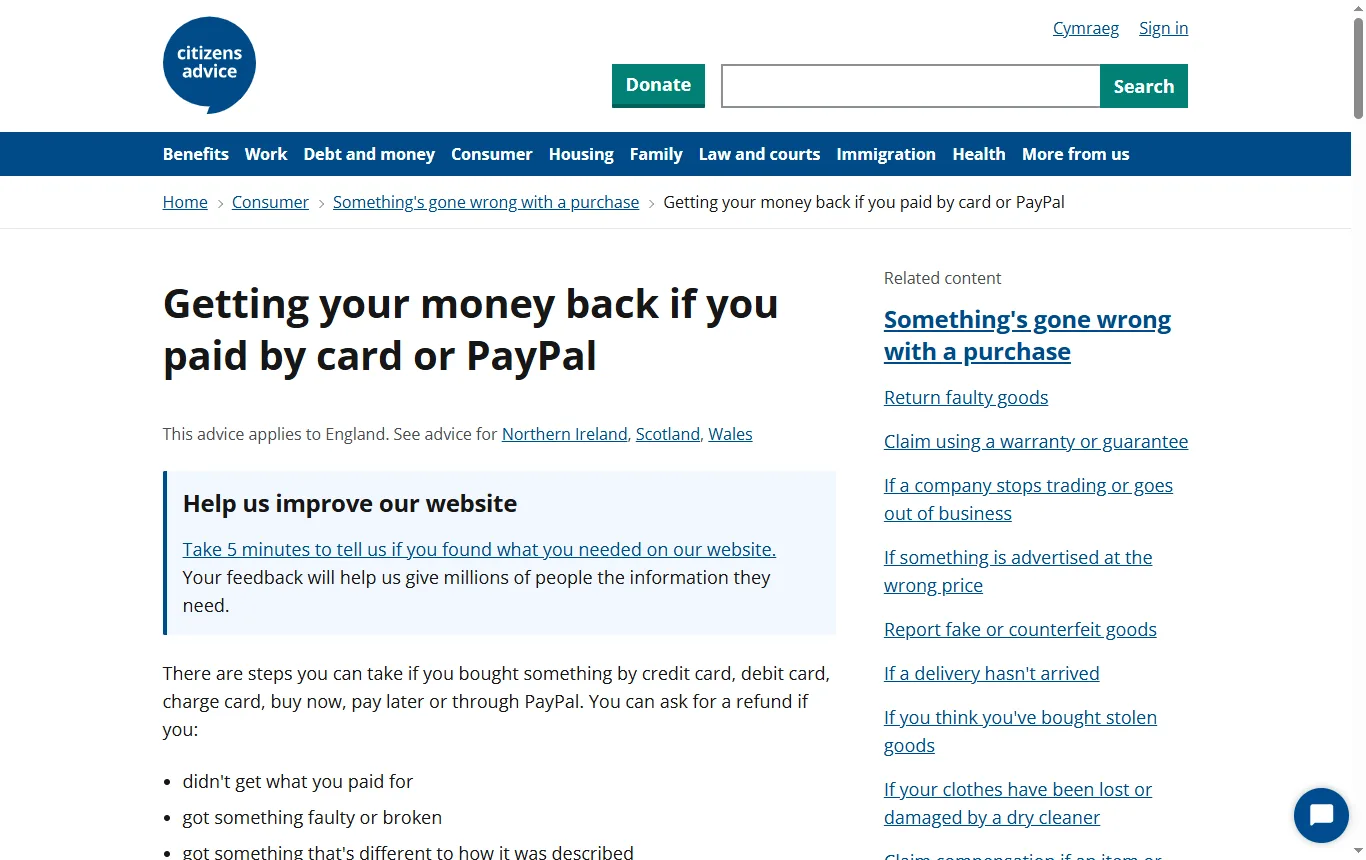
Section 75 of the Consumer Credit Act makes your credit card provider jointly responsible for a failed purchase. Citizens Advice says it applies if you paid more than £100 and no more than £30,000 for a single item, and that the limits apply to each item rather than the whole order.
The catch for travel is that Citizens Advice also says you usually cannot use Section 75 if you bought through a third party rather than directly from the trader, and it lists travel agents among the examples. You can still ask your provider, but it may refuse. For a debit card, or where Section 75 does not apply, Citizens Advice points to chargeback, and says you can ask for it even if you did not buy directly from the trader. For PayPal, a dispute is opened within 180 days, roughly six months. Citizens Advice gives no deadline for chargeback in the passage on card payments, so ask your card provider how long you have.
So paying a travel agent by credit card does not guarantee Section 75 cover. If a particular flight or hotel matters to you, ask your card provider before relying on it.
Is Trip.com okay for railcards?
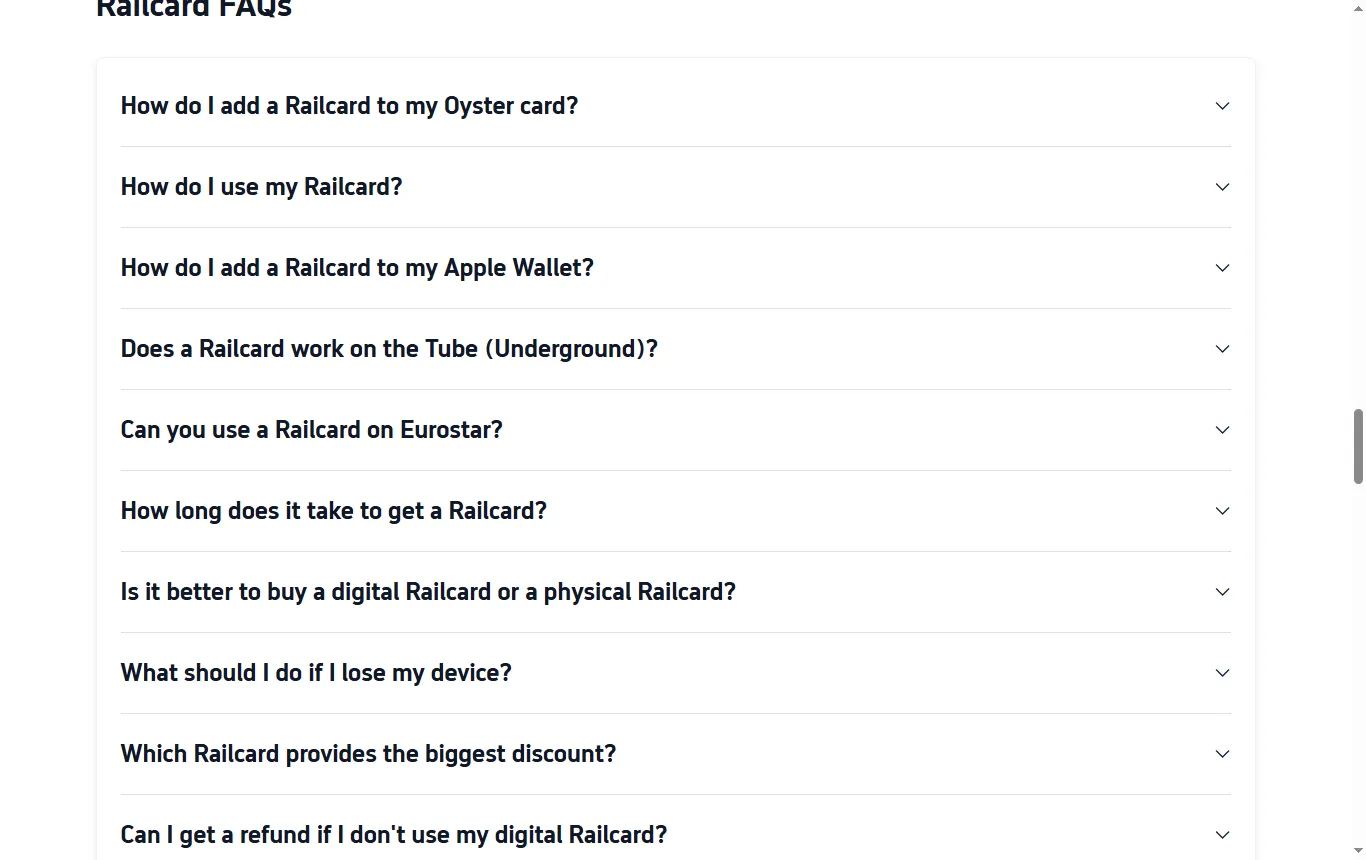
Trip.com's UK railcard page says you can buy a digital Railcard in your Trip.com account, saved on up to two devices, and select it when booking. The discount applies only to selected train fares, Eurostar is not part of the scheme, and you may need to show the Railcard with your ticket on the train. The page states Railcards are non-refundable once issued.
The National Railcard site adds the bigger picture: most Railcards are valid across Great Britain, the Network Railcard is limited to London and the South East, and the 26-30 Railcard is digital only. It also says most standard cards take about a third off train tickets.
The sensible approach is to check on the National Railcard site that your card suits your journey, then compare the final train price with the train operator's own site. A discount that applies only to selected fares can be worth less than a cheaper fare elsewhere.
How do you book on Trip.com without nasty surprises?
The same habits apply to any intermediary. They take about five minutes.
- Read the fare rules of the exact offer. Look for a free cancellation deadline before you pay, not after.
- Compare the total on the first and last screens. Reviewers mention prices moving during booking.
- Check names against your passport, and keep the email address on the booking consistent with the one you give the airline.
- Wait for confirmation before committing anything else. Do not pay for a non-refundable hotel because a flight is "pending".
- Keep proof. Screenshots of the conditions, the confirmation email and the booking number.
- Compare with the supplier's own site. A gap in price or flexibility is useful information either way.
Your account deserves the same care as the booking. It holds passport names, payment details and itineraries, so give it a password you use nowhere else; our guide to the best password manager → explains how to keep dozens of them without reusing any.
For help, the UK help page lists phone support only: 0113 868 8886 within the UK or +44 20 3856 8674 from abroad, available around the clock for flights, hotels, trains and cars, and from 2:00 am to 7:00 pm UK time for other bookings. It says charges may apply to international calls. Numbers change, so read them on the live page before you ring.
Is it safe to book on hotel or airport Wi-Fi?
Booking involves your name, card details and passport information, so the network you use matters. Open Wi-Fi in hotels, stations and airports is shared with strangers, and you cannot check how it is set up. Some habits cost nothing: use mobile data for the payment step, check that the address begins with https and shows the right domain, keep your phone and apps updated, and avoid reusing the password of your email account on a travel account.
A VPN is one further option. It encrypts the traffic between your device and the VPN provider's server, which is useful on a network you do not trust, though it does not protect you from a fake booking site or a weak password. Our NordVPN review → looks at one provider, and the two services suggested above are the ones in our catalogue.
What should you do if something goes wrong with a booking?
Work through the chain in order, and keep a written trail at every step.
- Contact Trip.com first through the help page, quoting the booking number, and note the date, the time and the name of the person you spoke to.
- Contact the airline or hotel if the problem is the service itself, such as a cancelled flight or a room that does not match the description. Flight compensation is owed by the airline, as explained above.
- Ask your card provider about Section 75 or chargeback, depending on how you paid, and say clearly that you bought through an agent.
- Use free advice. Citizens Advice has a page on getting your money back if you paid by card or PayPal, which sets out the rules described in this review.
Do not wait for a perfect answer before moving to the next step if a deadline is close, especially with PayPal, where the dispute window is 180 days.
Should you book with Trip.com or direct?
| Situation | Trip.com may suit | Booking direct may suit |
|---|---|---|
| Comparing several hotels in one city | Yes, comparison is the platform's job | Check the price on the hotel's site once you have chosen |
| You may need to cancel | Only with a refundable rate you have read carefully | The hotel's own terms are often clearer |
| Dates still uncertain | Avoid unless the fare is flexible | Usually better |
| Short connection between flights | Watch confirmation delays | Usually better |
| You want a person on the phone | Possible, check the hours | Depends on the hotel or airline |
This page reviews one service and does not rank booking platforms. Readers often ask how Trip.com compares with Booking.com or with lesser-known names; the honest answer is to run the same six checks listed above on each platform and compare the total, the cancellation terms and the support hours.
Not sure? Describe your trip
Frequently asked questions
Is Trip.com legit?
It is a real company with a listed parent group, a UK site with published terms and an ATOL licence number quoted in those terms. Legitimacy is not the same as a flawless service, so read the conditions of your own booking.
Is booking through Trip.com okay?
For many people, yes, provided you choose a rate whose cancellation terms you have read and you keep every confirmation. Reviewers report mostly good experiences and a minority of problems with confirmations, price changes and support.
Is Trip.com okay for railcards?
Trip.com says you can attach a digital Railcard to selected train fares, but not Eurostar. Check the fare and the railcard terms, and compare with the operator's site.
Is Trip.com an authentic website?
The UK site publishes terms of service, a help page with contact numbers and an ATOL licence number for flight sales. You can check any ATOL claim in the Civil Aviation Authority's "Check an ATOL" search.
Do I get compensation if my flight is cancelled?
Possibly. The Civil Aviation Authority says compensation may be available when you received less than 14 days' notice, unless the cause was outside the airline's control. You always have the right to a refund or alternative flight.
Can I cancel a hotel on Trip.com for free?
Only if the rate you chose allows it. The terms say rights vary by product and are shown during booking, and some rooms are not changeable or refundable.
See also
 ComparisonBest portable power station in the UK: how to choose one safelyHow to choose a portable power station in the UK: watt-hours, output, recharging, flying, safety and three Amazon.co.uk searches. No ranking, no prices.
 ReviewProton Pass review: what the free plan includes and how safe it isProton Pass reviewed from official pages and NCSC advice: what the free plan includes, audits by Cure53 and Recurity Labs, and the limits to know.