Déclic · Guides · Websites & selling online
Review
Shopify pricing in the UK: plans, fees, VAT and what to check

Ad: this page contains affiliate links. If you sign up through them, Déclic earns a commission at no extra cost to you. Our opinions are our own.
In brief
Shopify sells four main plans (Basic, Grow, Advanced and Plus), shown in pounds on its UK pricing page, with a three-day free trial and a toggle between monthly and yearly billing (October 2026). The subscription is only part of the bill: card and wallet fees, any third-party transaction fees, apps and a domain come on top. This page deliberately shows no amounts, because they change; it shows you how to read the pricing page and how to estimate a realistic monthly cost for your own shop. Shopify suits people who want a hosted shop that is mainly about selling products and are happy to pay for convenience. It suits less someone selling a handful of items a year who could use a simpler route.
Who it suits: small businesses and creators launching an online shop who want hosting, checkout and payments in one place. Who it does not suit: occasional sellers, or anyone who needs a very customised site and a tiny budget at the same time.
How much does Shopify cost in the UK?
Shopify's UK pricing page lists the plans Basic, Grow, Advanced and Plus, with Agentic and POS Pro presented as options alongside them. Prices appear in pounds and a "Pay monthly" and "Pay yearly" toggle lets you compare billing options. No amount is copied here: promotions and plan changes can alter the page within days, and an old figure would mislead you. Open Shopify on the day you decide and read the live numbers.
What you can do instead is build the number yourself. Before you open an account, write down:
- The subscription for the plan you would really use, on the billing period you would really choose.
- The payment cost per order: the percentage and any fixed fee for the cards and wallets your customers use, from the fee lines on the pricing page.
- Third-party transaction fees, if you do not use Shopify's own payment system (see below).
- Apps: the monthly cost of each app you rely on, shown on its own listing.
- A domain name and any extras such as a custom email address.
- Your time for setup, photography, product descriptions and customer service.
A rough monthly cost is then the subscription, plus orders multiplied by the cost of each order, plus apps and domain. Run it with a cautious number of orders and a generous one. If the cautious figure already makes the shop unprofitable, the plan is not the real problem.
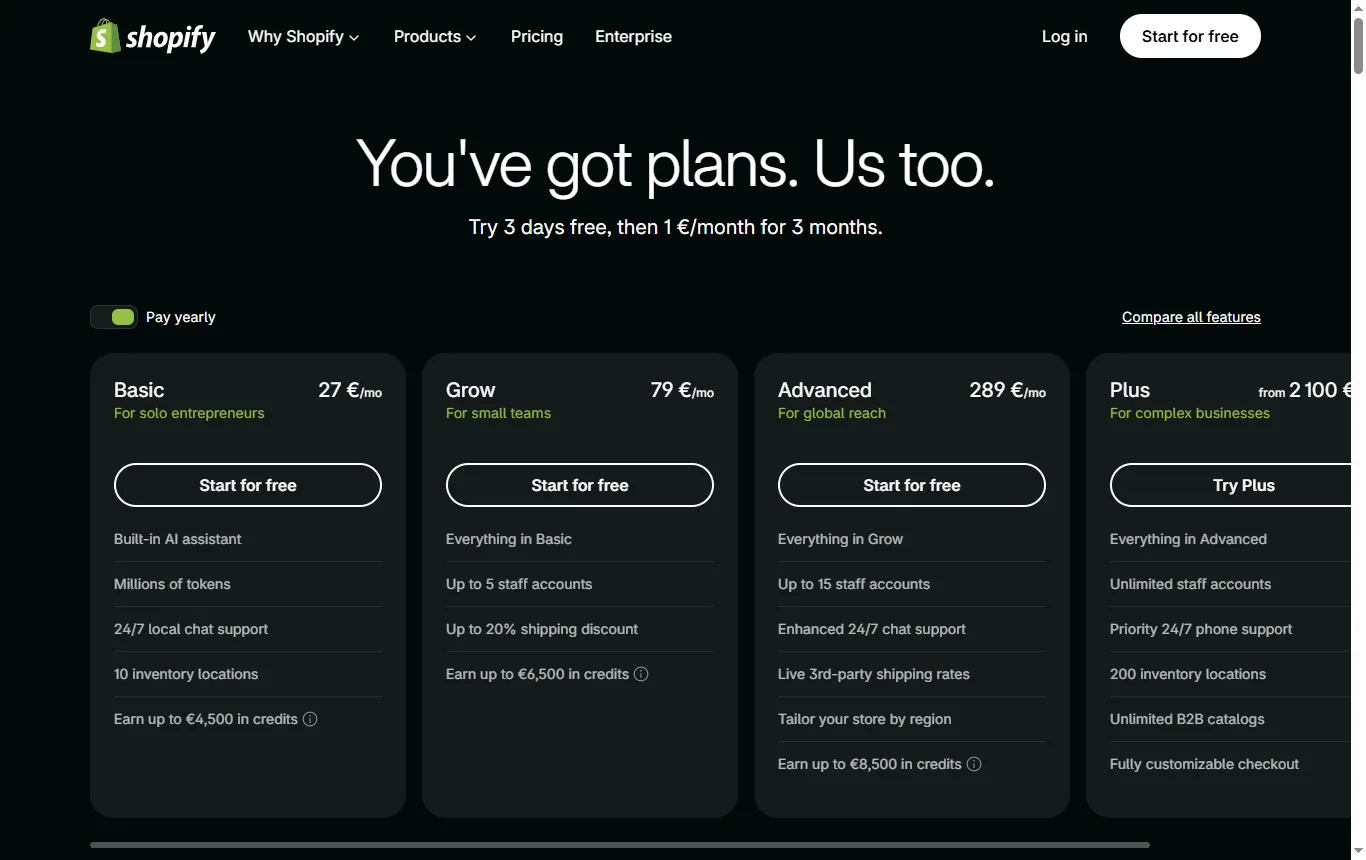
What do the Shopify plans include, and where do the limits sit?
The pricing page gives a limits table that is more useful than the headlines. The differences it states:
| Feature | Basic | Grow | Advanced | Plus |
|---|---|---|---|---|
| Additional staff accounts | Not included | 5 | 15 | Unlimited |
| Inventory locations | 10 | 10 | 10 | 200 |
| B2B catalogues | Up to 3 | Up to 3 | Up to 3 | Unlimited |
| Headless storefronts | 1 | 1 | 1 | 25 |
Three things stand out. First, staff accounts are what separates Basic from the plans above it: if someone else needs to log in to fulfil orders or answer customers, check whether Basic works for you. Second, inventory locations are generous on every standard plan, so a small business is unlikely to hit that limit. Third, Plus is a different category, aimed at large operations, and most readers of a page like this will not need it.
Two further items appear beside the plans. "Agentic" is presented as an option for selling through AI shopping channels, with no monthly fee and payment only when you make a sale. "POS Pro" is an add-on for in-person selling, priced per location, with a list of locations included for Basic, Grow and Advanced. If you only sell online, you can ignore POS Pro, and you can treat Agentic as an experiment to cost separately rather than as a replacement for a normal shop.
Who should pick which plan?
The headline question, "which plan?", is easier once you describe your business in three lines.
- You are testing an idea alone. Basic is the natural starting point. You are the only person logging in, and you can move up later if the shop grows.
- You have a partner or one helper who packs orders. Staff accounts are the deciding feature, so compare Basic with Grow on that line alone before looking at anything else.
- You sell to other businesses as well as to the public. Look at the B2B catalogue line, and at whether wholesale customers need their own price lists.
- You run more than one stockroom, pop-up or market stall. Count your inventory locations honestly, including a spare room or a shared unit.
- You turn over serious volume. Only then does it make sense to read the Plus page, which is a conversation with a sales team more than a price.
Billing period matters as much as plan. A yearly payment ties up more cash at the start, and a monthly one keeps you flexible. If you have never sold online before, flexibility is usually worth more than the discount.
How long is the Shopify free trial, and what happens after it?
Shopify's pricing page advertises a three-day free trial on the standard plans (October 2026), and the Plus plan carries a separate "Try Plus" button; Shopify's help centre says you can upgrade later to add features. After the trial, Shopify has promoted a low-priced introductory period on some country versions of its pricing page, so look for any such offer on your own screen before choosing a billing period. Whether the sign-up form asks for a payment card is something to check as you register, rather than something to assume.
Three days is short. Treat it as time to do something specific rather than to browse: add three products, set a delivery rate, try the checkout as a customer, and see whether the theme editor feels workable. Then decide with the pricing table beside you.
What payment and transaction fees does Shopify charge?
The pricing page lists fee lines that vary by plan: online standard card rates, American Express rates, international card rates, Klarna rates, local payment methods (the page names Bancontact, iDEAL, TWINT, MB WAY and Bizum), in-person card rates, USDC rates and third-party transaction fees. No percentages are copied here; read them on the live page for the plan you intend to use.
The most important rule is in Shopify's help centre. If you use Shopify Payments as your primary provider, orders processed through Shopify Payments, Shop Pay and Shop Pay Installments carry no third-party transaction fees, and neither do manual methods such as bank transfer. If you use Shopify Payments alongside another payment provider, transaction fees apply. In other words, the cheapest route is usually the one the platform designs around, and a decision to use another gateway should be taken with the fee lines in front of you.
Shopify's help centre lists the United Kingdom among the countries where Shopify Payments is supported. It also says you must be in a business type that is eligible and provide identity, address and business registration documents, so check the requirements before you design your whole checkout around it.
Do Shopify prices include VAT, and when must you register?
The UK pricing page lists "VAT validation, exemptions, and invoicing" as a tax feature included on every plan, but it does not say whether the plan prices shown include or exclude VAT. Look at the invoice terms during checkout of your subscription and ask Shopify's support if it is unclear.
Separately, your own shop may have to charge VAT. GOV.UK ("Register for VAT") says you must register if your taxable turnover for the last 12 months is over £90,000, or if you expect it to exceed that in the next 30 days, and you can register voluntarily below the threshold. Whether voluntary registration makes sense depends on who your customers are, and that is a question for an accountant. Whatever you decide, decide before the first sale rather than after: prices set without VAT are painful to change later.
What costs sit outside the subscription?
Apps, themes and domains are not priced on the plan page, and they are the usual places where a bill grows. Check each one before you commit:
- Apps that add reviews, subscriptions, email capture or shipping features, each with its own monthly charge.
- A premium theme, if the free options do not suit you.
- Domain and email.
- Courier and packaging, which depend on what you sell.
- Photography and copywriting, which are the real determinants of conversion.
If email is part of your plan, a separate email tool may be worth costing in at the start; our Brevo review → explains what a free email plan does and does not cover. Keep a simple spreadsheet with one line per cost and one column for "monthly" and one for "per order". It is the same exercise as the six-line list above, kept up to date.
What do Shopify reviews say, and why is the Trustpilot score so low?
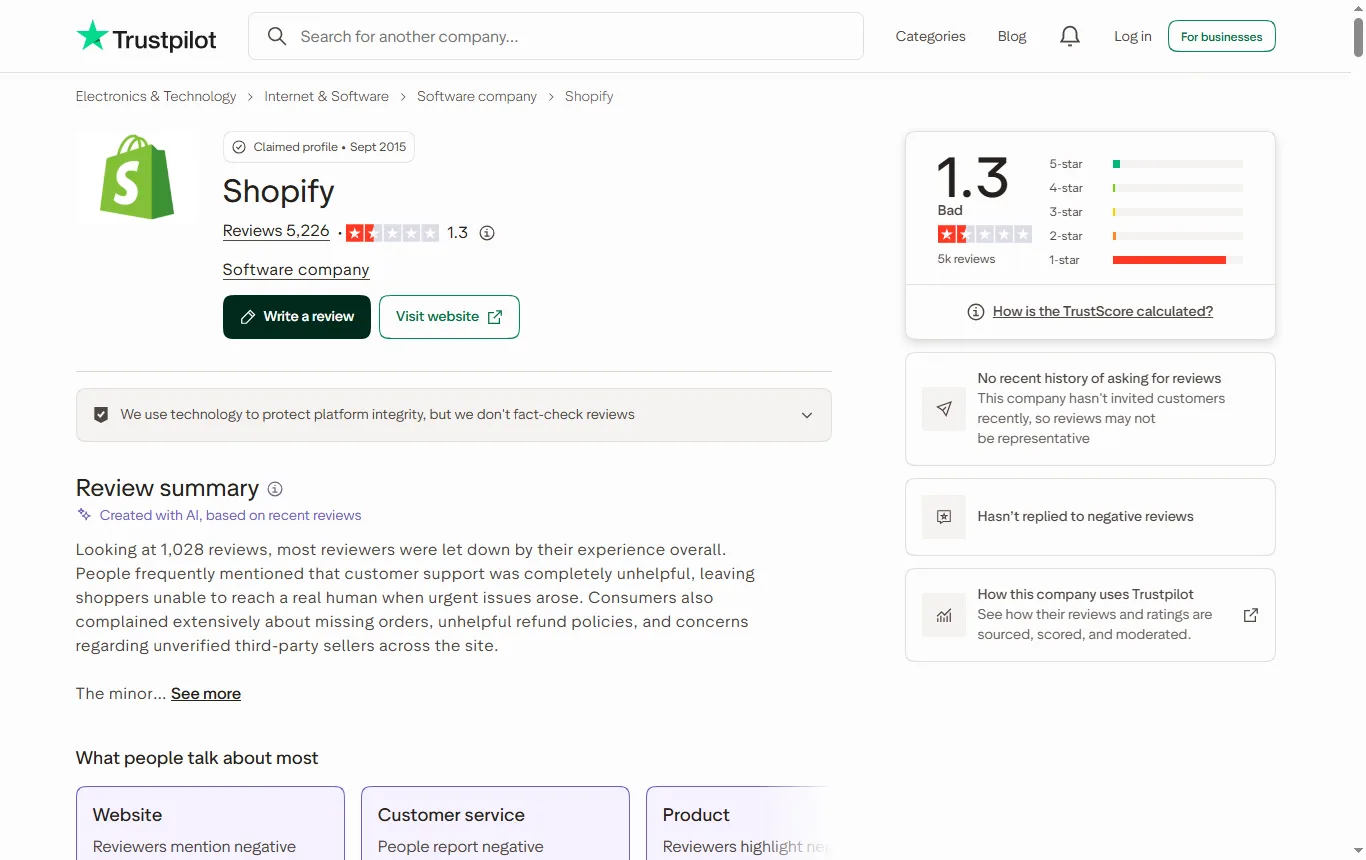
Trustpilot's UK page for Shopify (October 2026) shows a TrustScore of 1.3 out of 5 from 5,215 reviews, 1,393 of them in the last twelve months, and 87% of reviews are one-star. Trustpilot's own AI summary describes frustration with missing products, unhelpful customer service and difficulty resolving order issues, with a minority saying that setting up a store was straightforward.
Read this carefully before drawing a conclusion. Several of the reviewers say they were scammed by shops that run on Shopify and became unreachable, which means a large share of the criticism comes from shoppers rather than from merchants who pay for the software. That is a complaint about some shops, and the reviewers say Shopify did not help them, but it is not a measure of how the product works for a seller. Reviews written by sellers describe other themes, such as store suspensions and account closure after security requests, and they too are individual accounts.
A fairer way to judge the product is to try the trial and to look for seller reviews on forums and on platforms that verify business users. Ask in particular how long support took to answer, and what the seller did when an account was restricted.
What happens if you cancel Shopify or a payment fails?
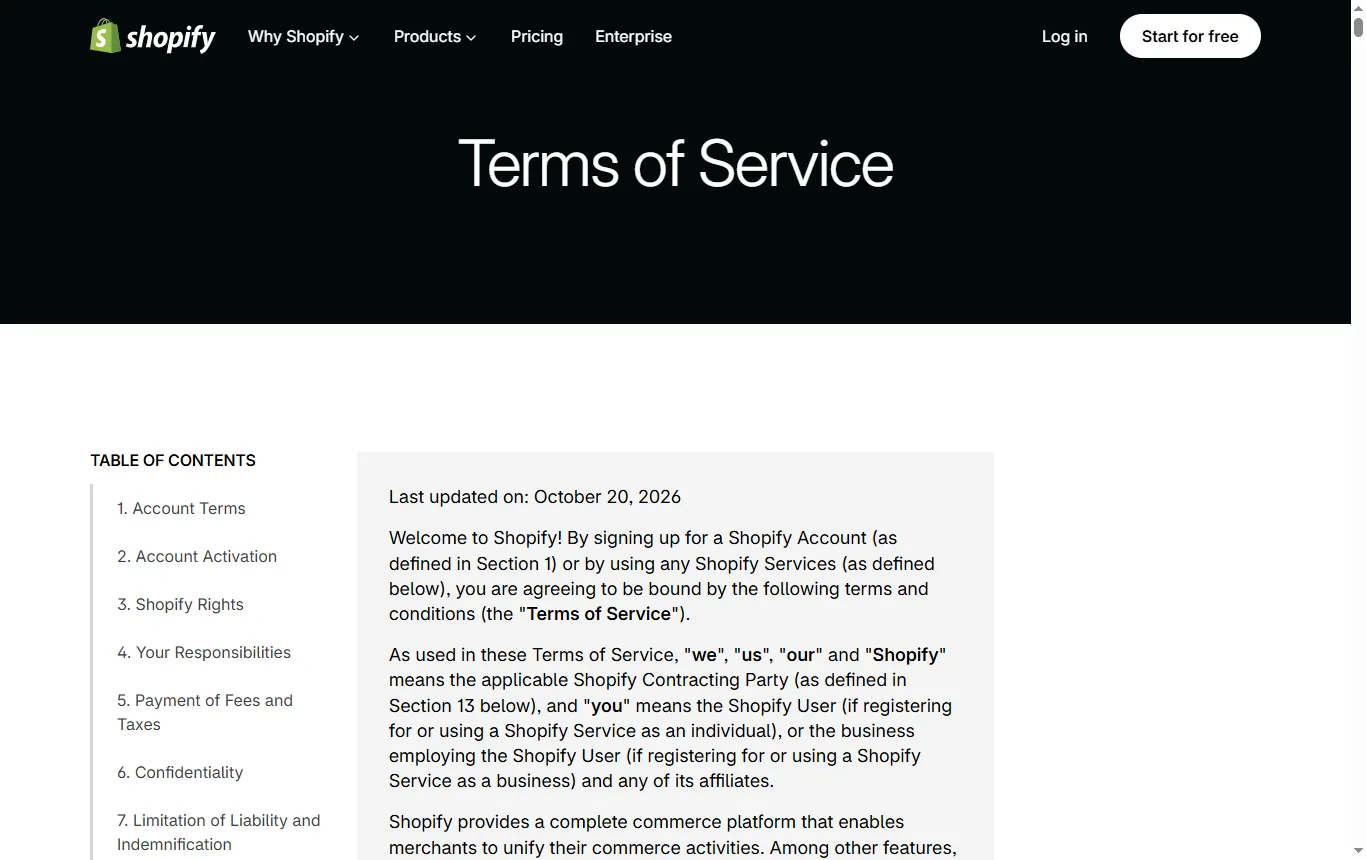
Shopify's terms of service (October 2026) are worth reading before you pay, because they set the rules that apply to a business account.
- Billing. Subscription fees are paid in advance, in cycles of 30 days. If a charge fails, Shopify can try again; if payment has not succeeded within 28 days of the first attempt, it may freeze the store until the unpaid fees and the next cycle's fees are paid.
- Cancelling. You contact Shopify's support, which explains the procedure, and you can cancel at any time. On cancellation there is no pro rata refund of fees unless the terms say otherwise, any balance owed falls due immediately, the store goes offline and a domain bought through Shopify is no longer renewed automatically.
- Long non-payment. If fees remain unpaid 60 days after a suspension, Shopify reserves the right to terminate the account.
- Billing mistakes. Raise a billing problem quickly: the terms give you roughly two weeks.
Two practical consequences follow. Cancel before a renewal date, not after it, because a payment already taken is not refunded for the part of the cycle you did not use. And export your products, customers and orders before you leave, because the store goes offline when the account closes. Shopify's UK terms may differ in detail from the text summarised here, so read the version shown when you sign up.
Does HMRC check Shopify sellers?
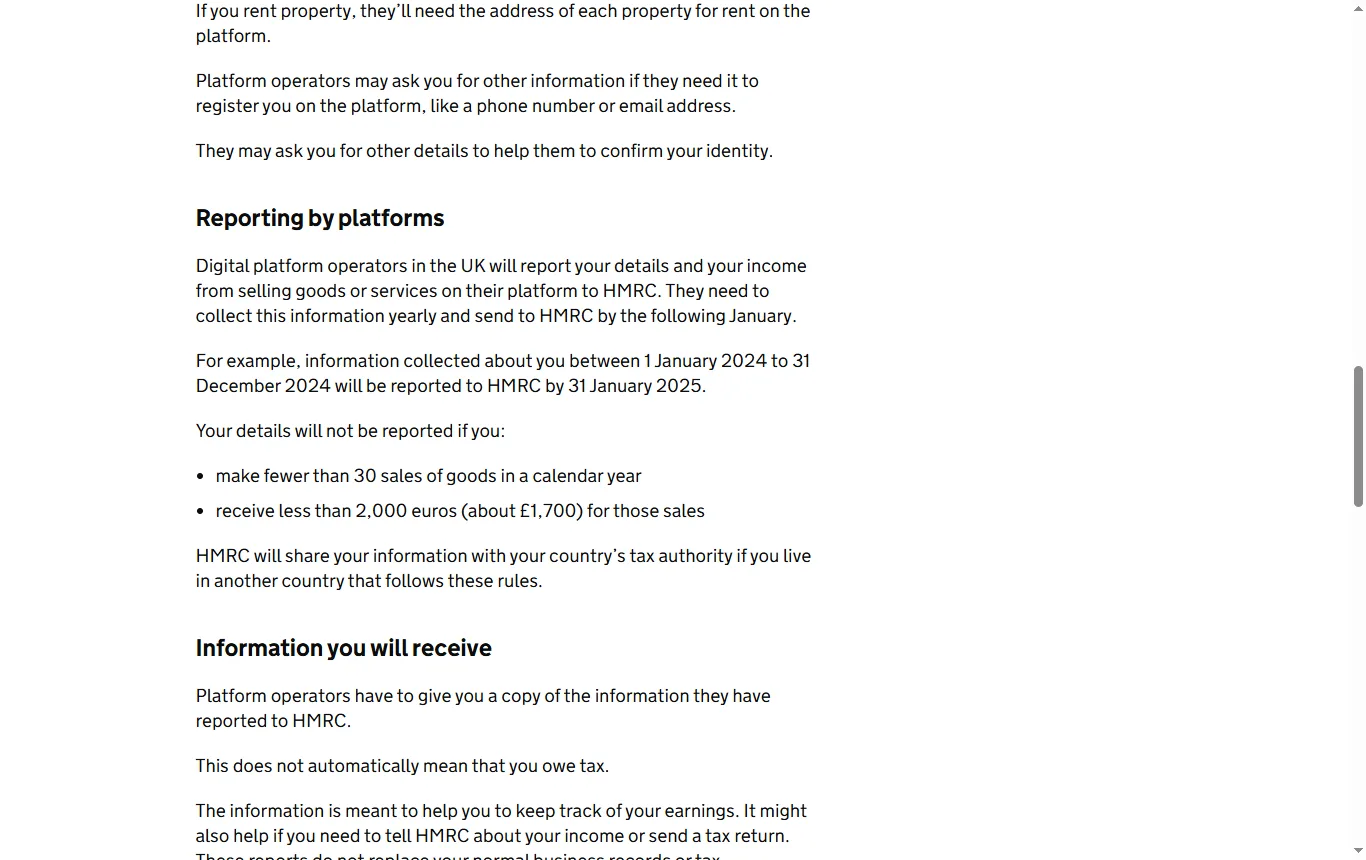
People search this question because platforms now report seller income to the tax authority. The GOV.UK guidance on selling goods or services on a digital platform (updated 22 September 2025) explains that digital platform operators report sellers' details and income to HMRC under rules that started on 1 January 2024, each year before 31 January. Details are not reported if a seller makes fewer than 30 sales of goods in a calendar year and also receives less than 2,000 euros (about £1,700) for those sales. The platform sends sellers a copy of what it reported.
Two important points from the same guidance. Being reported does not mean you owe tax: you generally pay tax only if you are trading or making a capital gain. And the report does not replace your own records or your tax calculations. The guidance describes platforms that connect sellers and buyers, and says nothing specific about a shop you run on your own Shopify store, so do not assume either way. If this matters to you, ask Shopify, read the GOV.UK page, or speak to an accountant.
Is Shopify worth it in the UK?
It is a reasonable choice if the following apply:
- You sell physical or digital products to the public and want a shop that stays online without you managing servers.
- You value a checkout you do not need to build yourself.
- You can estimate your orders and know your margin, so the monthly cost has a purpose.
Think again if you sell a few items a year, if your catalogue is tiny, or if the subscription alone would eat a large part of your first months' profit. In those cases a marketplace or a simpler page may do the job while you validate demand.
What should you ask before you choose a plan?
A short list of questions saves most of the regrets.
- What is my cautious monthly order count, and what is the cost of each order at that level?
- Does anyone besides me need to log in?
- Will I use Shopify Payments, or another provider that adds a transaction fee?
- Which apps do I really need in the first three months?
- Am I close to the VAT threshold, or likely to register voluntarily?
- How would I export my data and leave if the shop does not work out?
What are the alternatives to Shopify?
The searches that appear next to "Shopify alternatives" in the UK include WooCommerce and Wix. They are not assessed here and are not linked. If you are comparing, use the same six-line cost list above for each option, so that the numbers are comparable.
Not sure? Tell us what you want to sell
Frequently asked questions
How much does Shopify cost you?
It depends on the plan, the billing period and your sales. The UK pricing page lists four plans with monthly and yearly options and a three-day trial; see the cost checklist above to estimate your own total.
How much does Shopify UK cost per month?
Read the "Pay monthly" figure for the plan you want on the UK pricing page, then add payment fees, apps and your domain. No amounts are printed here because they change.
Is Shopify worth buying?
It is worth it if you will sell enough to cover the subscription and fees. The trial is the cheapest way to test whether the platform suits you.
Does HMRC check Shopify?
Platforms that connect sellers and buyers must report seller income to HMRC under rules that began on 1 January 2024. The GOV.UK guidance does not say how this applies to your own Shopify store, so check with Shopify or an accountant.
What is the downside of using Shopify?
Costs beyond the subscription (payment fees, apps), a short trial, no pro rata refund when you cancel, and complaints from customers of some Shopify-powered shops, which reviewers sometimes attribute to the platform.
Is Shopify still worth it in 2026?
Only your numbers can answer that. Estimate orders, margin and costs for a cautious scenario and a generous one before you pay.
See also
 ReviewFilmora review: the free version, the plans and what to checkFilmora reviewed from official pages and Trustpilot UK: free-version watermark, annual or perpetual plans, AI-content rights, refunds and free alternatives.
 ComparisonBest AI video generator: Kling, InVideo, DeeVid and PixVerseKling, InVideo AI, DeeVid and PixVerse compared on free credits, watermarks, resolution, commercial rights and cancellation, from the official pages.